

On this page
In kinematics, one of the classic problems in simple harmonic motion (SHM) asks you to find the defining constants of an oscillator when you only know its speed at two different points. You don't know the mass, the spring constant, or the maximum reach of the motion—just a pair of coordinates like (x₁, v₁) and (x₂, v₂).
Because the restoring force in SHM is conservative, the particle trades kinetic energy for potential energy as it moves away from equilibrium. By setting up the velocity-displacement relation at both points, you can systematically solve for the angular frequency (ω) and the amplitude (A).
How do you find the amplitude and time period from two velocities?
According to OpenStax University Physics, the magnitude of the velocity |v| of an oscillator at any displacement x is |v| = ω√(A² - x²). Squaring both sides removes the root and the absolute value, giving a very friendly quadratic relation:
v² = ω²(A² - x²)
This formula is the core of the method. To use it, simply write out the equation for both known positions:
v₁² = ω²(A² - x₁²)
v₂² = ω²(A² - x₂²)
You now have a system of two equations with two unknowns, A and ω.
How do you find the time period?
To find the time period, we first need the angular frequency ω. We can eliminate the amplitude A by subtracting the second equation from the first:
v₁² - v₂² = ω²(A² - x₁²) - ω²(A² - x₂²)
Expand the brackets on the right:
v₁² - v₂² = ω²A² - ω²x₁² - ω²A² + ω²x₂²
The ω²A² terms cancel out entirely, leaving:
v₁² - v₂² = ω²(x₂² - x₁²)
Rearranging for ω gives:
ω = √[(v₁² - v₂²)/(x₂² - x₁²)]
Once you have the angular frequency, the time period is simply T = 2π/ω.
How do you find the amplitude?
To find the amplitude, you can either substitute your numerical value for ω back into one of the original equations (which is usually faster on an exam), or you can eliminate ω algebraically to get a direct formula.
To eliminate ω, divide the first equation by the second:
v₁²/v₂² = ω²(A² - x₁²) / ω²(A² - x₂²)
Cancel the ω² and cross-multiply:
v₁²(A² - x₂²) = v₂²(A² - x₁²)
Expand both sides:
v₁²A² - v₁²x₂² = v₂²A² - v₂²x₁²
Gather the A² terms on the left and everything else on the right:
A²(v₁² - v₂²) = v₁²x₂² - v₂²x₁²
Solving for A gives the general amplitude formula:
A = √[(v₁²x₂² - v₂²x₁²)/(v₁² - v₂²)]
How does this work in practice?
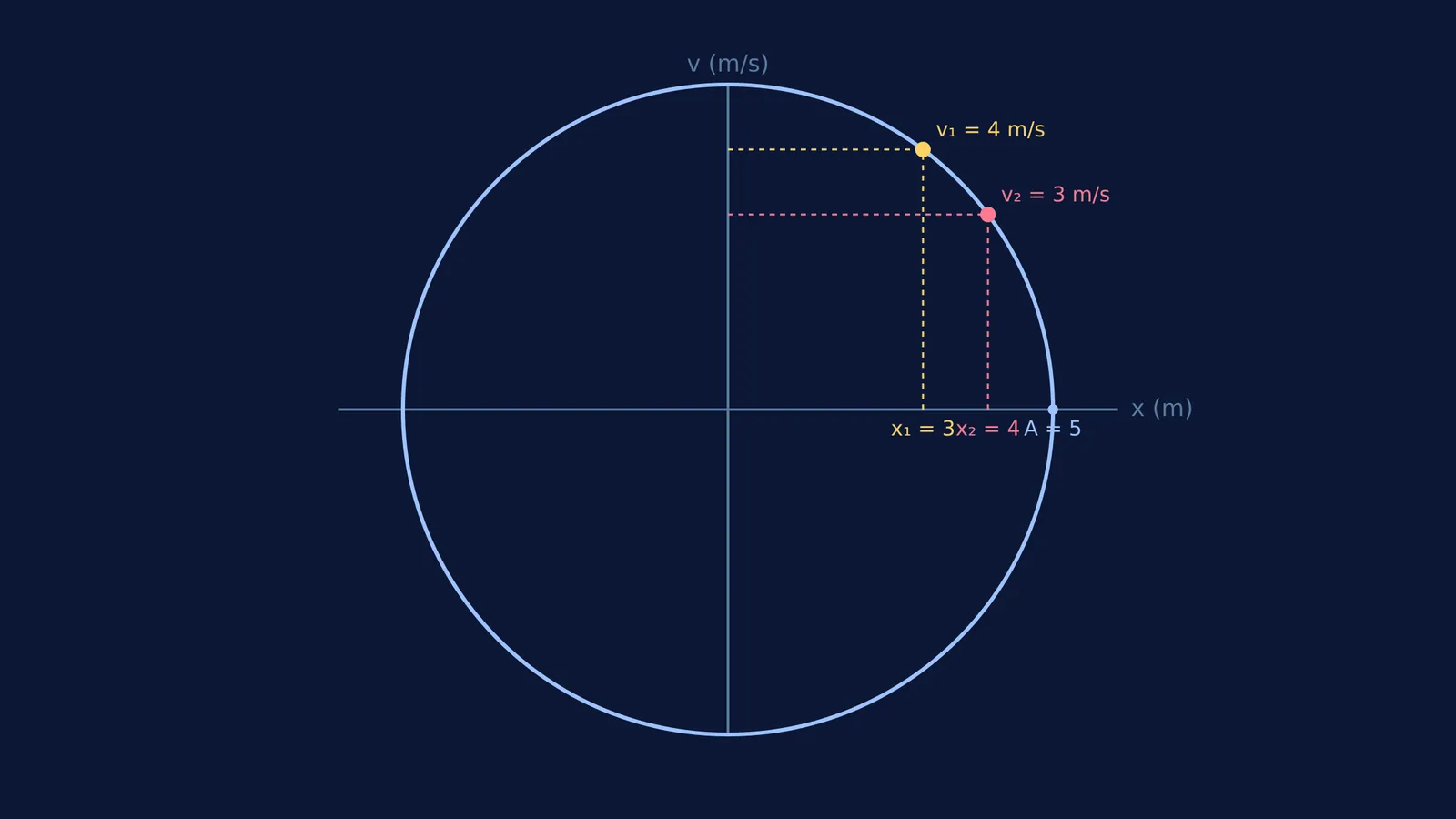
Let's put this into practice. A block on a spring has a velocity of 4 m/s when its displacement is 3 m, and a velocity of 3 m/s when its displacement is 4 m. Find its amplitude and time period.
First, set up the two equations: 16 = ω²(A² - 9) 9 = ω²(A² - 16)
Subtracting the lower equation from the upper equation gives: 16 - 9 = ω²(-9 - (-16)) 7 = ω²(7) ω² = 1, which means ω = 1 rad/s
The time period is T = 2π/1 = 2π seconds.
Now substitute ω² = 1 back into the first equation to find A: 16 = 1 × (A² - 9) A² = 25, which means A = 5 m
If you find yourself stuck setting up the substitution for similar exam questions, the Fermi Problem Library has a step-by-step solver that explains the reasoning rather than just printing an answer. Seeing the algebraic steps clearly mapped out can help you spot where you went wrong. Once you master the method, you can easily handle related applications, like calculating the simple pendulum string tension at any angle: mg cos θ + mv²/l or analyzing displacement and pressure waves in sound: the 90° phase shift.


