

On this page
In the ICSE Class 10 Chemistry syllabus under the "Study of Compounds" unit, few topics appear on board exams as consistently as the reactions of ammonia with metallic oxides and chlorine. The Council for the Indian School Certificate Examinations (CISCE) tests these transformations to evaluate whether students understand ammonia's reducing property and stoichiometry.
Students frequently lose marks because the equations appear similar while the products diverge completely when conditions change. Passing dry ammonia over heated copper(II) oxide produces reddish-brown copper, but reacting ammonia with chlorine yields two different outcomes depending on which gas is in excess. Tracing the oxidation states and mole ratios turns these memory traps into predictable chemical logic.
How does ammonia reduce heated copper(II) oxide?
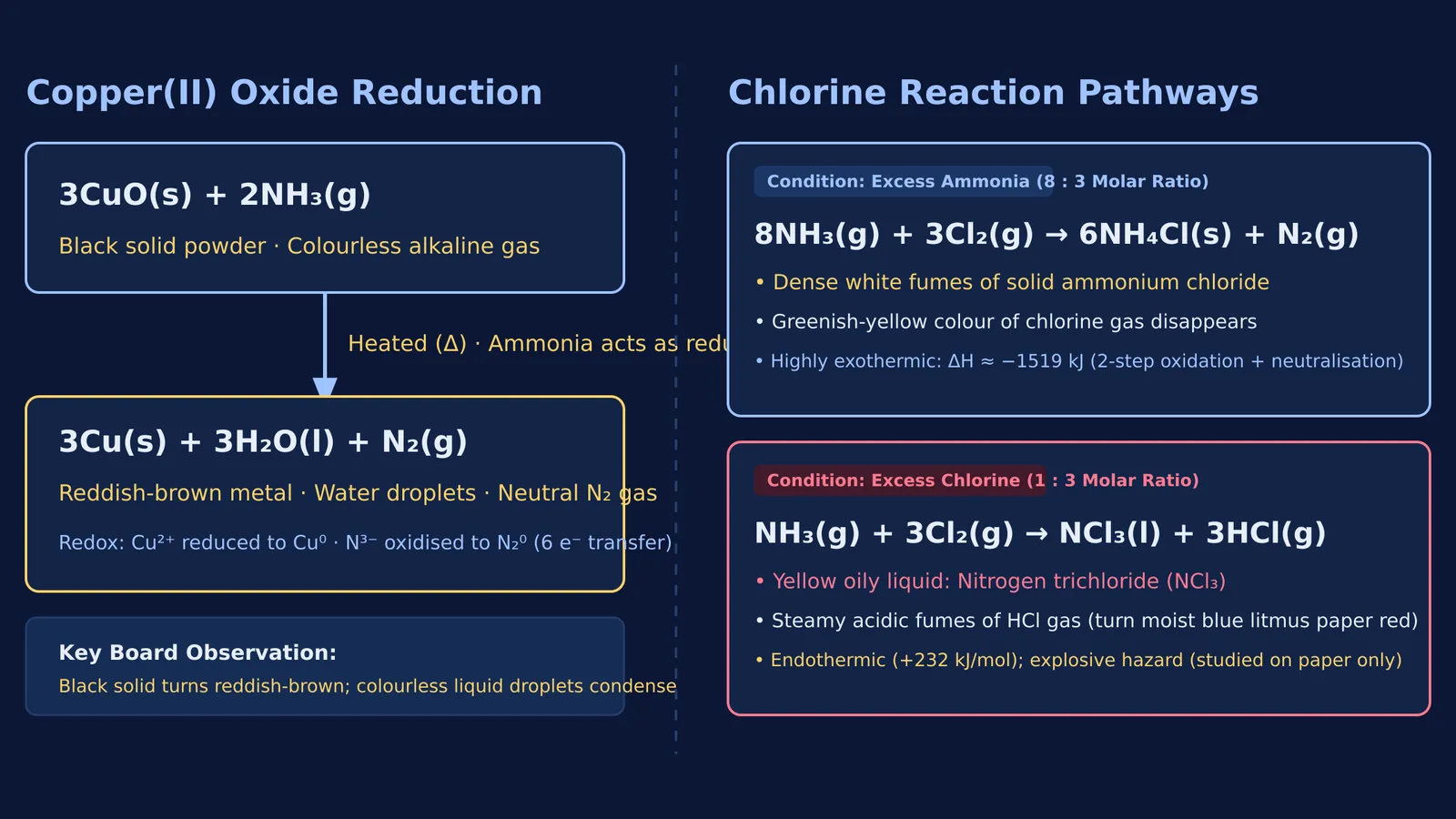
When dry ammonia gas is passed over heated copper(II) oxide in a combustion tube, ammonia acts as a reducing agent. The black copper(II) oxide is reduced to reddish-brown copper metal, while ammonia is oxidised to dinitrogen gas:
3CuO + 2NH₃ → 3Cu + 3H₂O + N₂
The visual changes are distinct:
Black copper(II) oxide powder turns into reddish-brown metallic copper.
Colourless droplets of water condense on the cooler parts of the tube.
A colourless, odourless, neutral gas (nitrogen) evolves, extinguishing a burning splint.
Solid copper(II) oxide has a standard enthalpy of formation of −156.1 kJ/mol according to the NIST Chemistry WebBook entry for copper oxide, while ammonia gas has an enthalpy of formation of −45.9 kJ/mol (NIST entry for ammonia). Supplying heat overcomes the kinetic activation barrier. In redox terms, copper is reduced from +2 to 0, while nitrogen is oxidised from −3 to 0. A total of 6 electrons transfer for every 3 formula units of CuO reduced.
What happens when ammonia is in excess with chlorine?
When ammonia reacts with chlorine, the products depend strictly on which reactant is in excess. With ammonia in excess, the reaction proceeds in two steps.
First, chlorine oxidises ammonia to dinitrogen and hydrogen chloride:
2NH₃ + 3Cl₂ → N₂ + 6HCl
Because ammonia is in excess, unreacted basic ammonia neutralises the acidic hydrogen chloride:
6NH₃ + 6HCl → 6NH₄Cl
Combining both steps gives the balanced equation required on ICSE mark schemes:
8NH₃ + 3Cl₂ → 6NH₄Cl + N₂
This reaction is strongly exothermic. Data from the NIST Chemistry WebBook lists the enthalpy of formation of solid ammonium chloride at −314.43 kJ/mol, releasing approximately 1519 kJ of heat across the 8-to-3 molar ratio. The heat vaporises ammonium chloride, which condenses in air into dense white fumes of solid NH₄Cl particles while the greenish-yellow colour of chlorine gas disappears.
What happens when chlorine is in excess with ammonia?
When chlorine is in excess, the chemistry changes completely. Instead of forming ammonium chloride, chlorine displaces all three hydrogen atoms from ammonia:
NH₃ + 3Cl₂ → NCl₃ + 3HCl
Under these conditions, two observations occur:
A yellow, oily liquid separates, which is nitrogen trichloride (NCl₃).
Steamy fumes of hydrogen chloride gas evolve, turning moist blue litmus paper red.
According to compound records in PubChem, nitrogen trichloride (CAS 10025-85-1) has a boiling point of 71 °C and a positive enthalpy of formation of +232 kJ/mol. Because formation of the N≡N triple bond releases 945 kJ/mol, nitrogen trichloride decomposes explosively into nitrogen and chlorine gas upon slight heat or shock. French chemist Pierre Louis Dulong discovered the compound in 1811 and lost an eye to an explosion, prompting Humphry Davy to investigate the substance in his 1813 Royal Society report.
How should you write these observations in the ICSE exam?
To earn full marks on CISCE board chemistry examinations, follow three checkpoints:
Identify the excess reactant: Check whether the prompt specifies "excess ammonia", "excess chlorine", or "heated copper oxide". Excess chlorine produces NCl₃ and HCl, never NH₄Cl.
State visual observations: Mark schemes require colours and physical states. Write "black solid turns reddish-brown" for CuO, "dense white fumes" for excess ammonia, and "yellow oily liquid" for excess chlorine.
Verify stoichiometry: Balance equations with exact integer coefficients. Excess ammonia with chlorine requires an 8:3 ratio to form 6NH₄Cl and N₂.
Connecting these reactions to broader principles prevents rote confusion. Reviewing retrieval practice routines for inorganic chemistry helps cement colour transitions, while practising stoichiometric and mole concept calculations ensures you balance volume ratios correctly. You can also read about Pierre Louis Dulong's work on atomic heat capacity to see how early chemists quantified reaction energies.
If you struggle to predict products from oxidation numbers, the Fermi Concept Library covers every concept across chemistry curricula to help you map reaction pathways. When working through past board questions, the Fermi Problem Library provides worked problems with a step-by-step solver that explains the reasoning rather than printing an answer.


