

On this page
Amines are organic derivatives of ammonia. Just like ammonia, the nitrogen atom in a typical alkylamine is sp³ hybridised, giving it a trigonal pyramidal shape. However, this geometry is not fixed. The exact bond angle around the nitrogen depends heavily on what is attached to it—whether it is a bulky alkyl group or a flat benzene ring.
For students preparing for JEE or NEET, understanding why these angles change is a classic test of how well you can balance steric hindrance against resonance.
What is the bond angle of trimethylamine?
In a perfect tetrahedral molecule like methane, the bond angle is 109.5°. When you move to ammonia (NH₃), the nitrogen atom has three bond pairs and one lone pair. Because a lone pair exerts more repulsion than a bond pair, the bonds are pushed closer together, compressing the H–N–H angle to 107.3°.
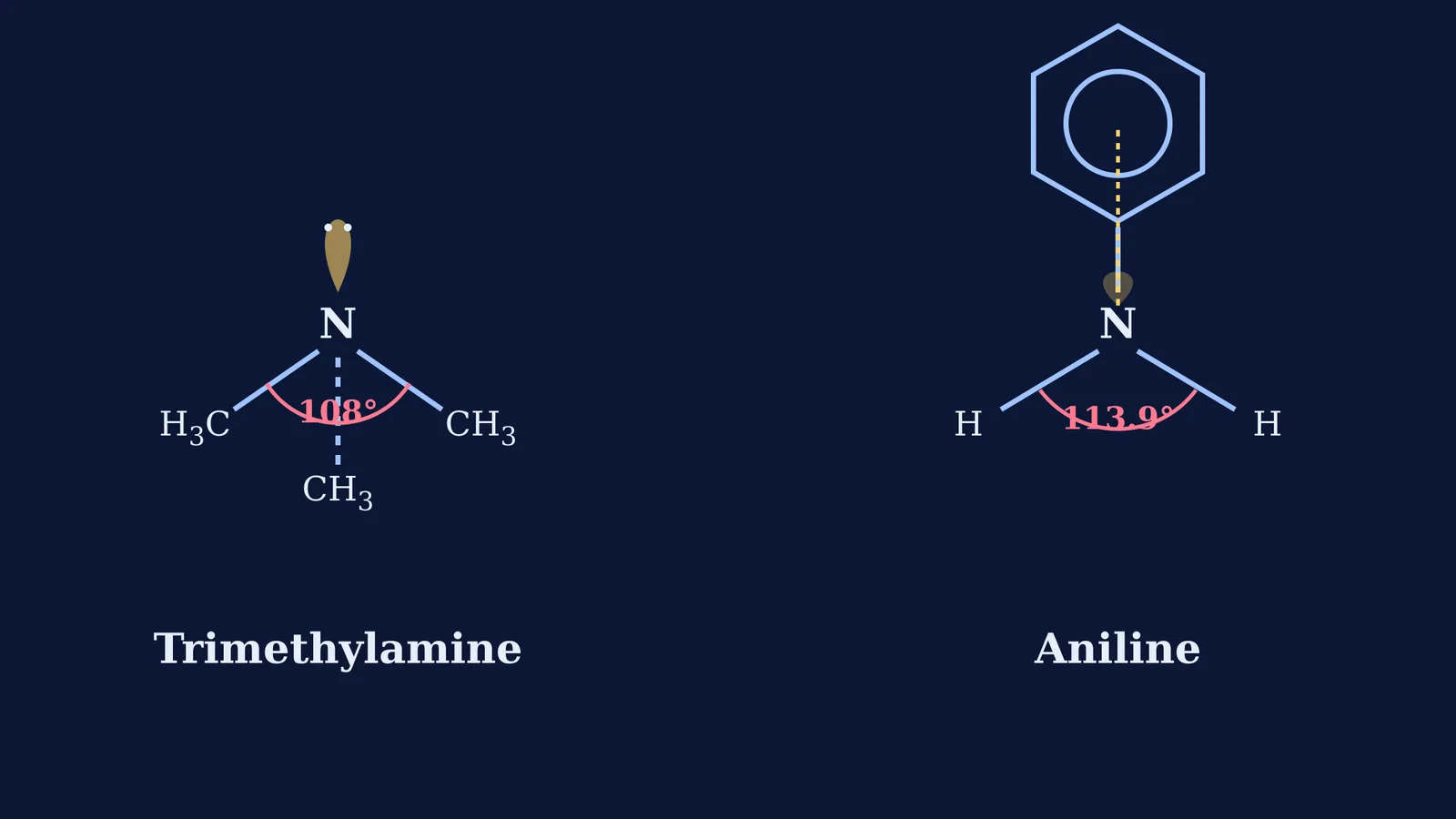
In trimethylamine ((CH₃)₃N), there are two competing effects. The lone pair still pushes the bonds down, but the three bulky methyl groups crowd each other. This steric hindrance pushes the bonds slightly back open. The result is a C–N–C bond angle of 108°. This balance makes the trigonal pyramid of trimethylamine slightly wider than ammonia, but still distinctly pyramidal.
If you are studying other groups from the p-block, see our guide on Comparing bond angles: NH₃ vs PH₃ and H₂O vs H₂S explained.
Why is the nitrogen in aniline flatter?
Aniline (C₆H₅NH₂) behaves differently because it features an aryl group instead of an alkyl group. Its nitrogen atom sits directly next to the conjugated π-system of a benzene ring.
Instead of remaining isolated in an sp³ orbital, the nitrogen lone pair delocalises into the benzene ring through resonance. To overlap effectively with the ring's p-orbitals, the nitrogen atom adopts a geometry much closer to sp² hybridisation. As a result, aniline has a shallow pyramidal—nearly planar—geometry, with an H–N–H bond angle of approximately 113.9°85039-8).
When you draw the resonance structures for aniline, you will notice that the lone pair on the nitrogen atom forms a double bond with the adjacent carbon atom of the benzene ring. This delocalisation pushes electron density into the ortho and para positions of the ring. For a true double bond to form, the nitrogen must have an unhybridised p-orbital parallel to the p-orbitals of the carbon atoms in the ring. To achieve this, the nitrogen shifts from sp³ hybridisation towards sp² hybridisation. As it does so, the three atoms attached to the nitrogen (one carbon and two hydrogens) are forced to spread out into a flatter arrangement, which increases the H–N–H angle and makes the molecule nearly planar.
Because this lone pair is tied up in the ring, aniline is also a much weaker base than alkylamines. You can explore the chemical consequences of this in Amines and diazonium salts: basicity order and coupling reactions.
How to visualise amine structures?
Visualising how an orbital lone pair overlaps with a flat benzene ring can be difficult on paper. If you want to see how resonance changes hybridisation step-by-step, the Fermi Concept Library has a lesson for every concept in chemistry, placing each in a larger map. Alternatively, if these 3D shapes are easier to see than to read about, the Fermi Simulation Lab offers interactive simulations where you can rotate the geometries and inspect them from any angle.
Because the amine group in aniline is so highly reactive—the delocalised lone pair strongly activates the benzene ring—it often has to be temporarily masked during synthesis to prevent over-reaction. You can see how this works in practice in Why aniline is acetylated before nitration: protecting the amine.
Quick reference checklist
When comparing amine structures for exams, keep this progression in mind:


