

On this page
Textbooks give the alpha, beta and gamma comparison as a table to memorise. Every row of that table follows from two facts about each kind of radiation: its charge and its mass. Get those right and you can rebuild the rest in the exam hall.
What are alpha, beta and gamma radiation?
All three are ionising radiation. The US EPA defines ionising radiation as radiation with enough energy to knock electrons out of atoms.
An alpha particle is two protons and two neutrons bound together, which makes it a helium nucleus (HyperPhysics).
A beta particle is an electron emitted from the nucleus. In beta-plus decay the nucleus emits a positron instead (HyperPhysics).
A gamma ray is a photon, which the EPA calls a weightless packet of energy.
A magnetic or electric field sorts them into three distinct beams (HyperPhysics); see Paul Villard and the discovery of gamma rays.
How do alpha, beta and gamma compare, row by row?
Masses are from NIST CODATA (alpha-to-electron and proton-to-electron mass ratios). Ranges are from Japan's Ministry of the Environment and the EPA.
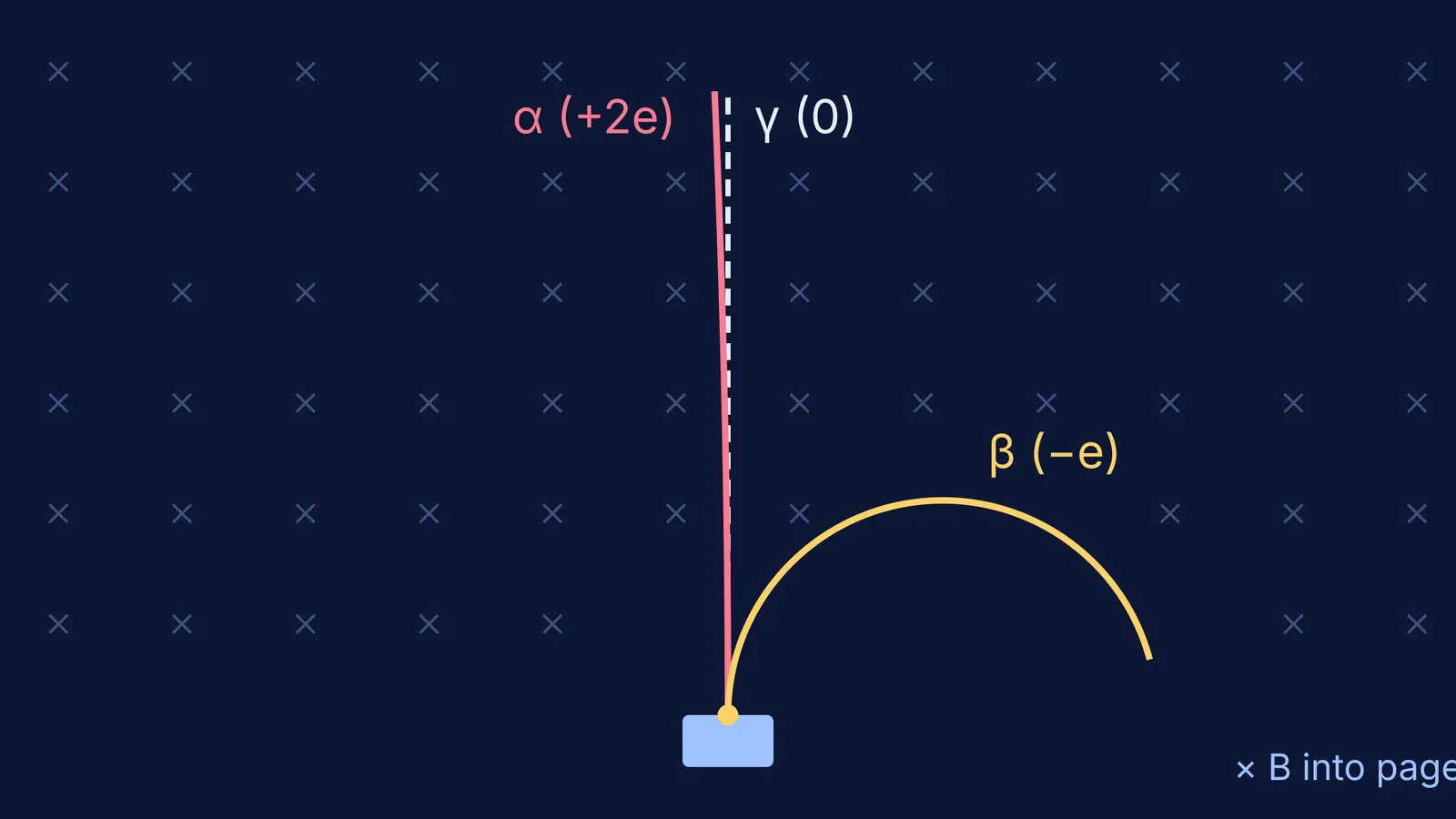
Charge. Alpha +2e, beta −e (β+ is +e), gamma 0. Why: alpha carries two protons, beta is a single electron, and a photon has no charge.
Mass. An alpha particle is 7,294.3 times the mass of an electron, which is about four proton masses. A beta particle has one electron mass. A gamma photon has no rest mass. Why: alpha has four nucleons, and beta is a single light lepton.
Ionising power. Alpha is strongest, beta is in between, and gamma is weakest. Why: the EPA notes that alpha ionisations are very close together, so an alpha particle can release all its energy in a few cells, while beta ionisations are more widely spaced. A large charge on a slow, heavy particle pulls hard on every electron it passes. An uncharged photon interacts only now and then.
Penetrating power. Alpha is weakest, beta is in between, and gamma is strongest. Alpha travels several centimetres in air and paper stops it. Beta travels several metres in air, and clothing or a thin layer of aluminium stops it. Gamma travels tens to hundreds of metres in air and can need several inches of lead or a few feet of concrete. Why: see the callout.
Deflection in a field. Alpha bends one way, but only slightly. Beta bends the opposite way, and strongly. Gamma goes straight. Why: opposite charges feel opposite forces, a large mass-to-charge ratio means a gentle curve, and zero charge means no force.
Short range is not the same as harmless: the EPA notes that alpha emitters inhaled, swallowed or entering a cut can damage living tissue.
Why does alpha bend less than beta in a magnetic field?
A charge moving at right angles to a field B moves in a circle of radius r = mv/(qB). Alpha has the bigger charge, but its mass is far bigger still.
Worked example 1: the same speed. With v and B equal, r is proportional to m/q. For alpha, m/q is 7,294.3/2 ≈ 3,647 in electron units. For beta it is 1. So the alpha radius is about 3,650 times larger.
Worked example 2: realistic energies. Take a 5 MeV alpha and a 1 MeV beta (our illustrative choices) in a 0.1 T field. Use r = p/(qB) and pc = √(K² + 2Kmc²). The electron rest energy is 0.511 MeV, and alpha's is 7,294.3 times that, about 3,727 MeV.
Alpha: pc ≈ 193.1 MeV, which gives r ≈ 3.2 m.
Beta: pc ≈ 1.42 MeV, which gives r ≈ 4.7 cm.
The ratio is about 68, so alpha still bends far less.
For direction, use F = qv × B: with the beam moving up the page and B into it, alpha curves left and beta right. Between charged plates, alpha drifts to the negative plate and beta to the positive. For the 3D case, see the helical path of a charge in a magnetic field.
If r = mv/(qB) is where your working goes wrong, the Fermi Problem Library has worked problems with a step-by-step solver that explains the reasoning rather than printing an answer.
How do you rebuild the table in an exam?
Use this five-step check instead of recalling rows:
Write the identity first: He nucleus, electron, photon.
Charge gives the deflection direction, and zero charge means gamma goes straight.
Mass-to-charge ratio gives how sharply it bends, so alpha curves gently and beta curves sharply.
Charge and slowness give the ionising order: alpha, then beta, then gamma.
Reverse that order for penetration: gamma, then beta, then alpha.
The same charge and mass bookkeeping drives counting alpha and beta decays in a decay series. To revise nuclear structure or the Lorentz force, the Fermi Concept Library gives each concept its own lesson and its place in the map.


