

On this page
A triple bond has two π bonds and a double bond has one, so most students expect alkynes to grab electrophiles like H+ or Br2 faster. They don't. This shows up as a "give reasons" question in board exams and as a reactivity-order question in entrance exams, and the answer rests on two ideas: how tightly the π electrons are held, and how unstable the next carbocation is.
Why are alkynes less reactive than alkenes to electrophiles?
According to William Reusch's Virtual Textbook of Organic Chemistry, electrophilic addition to alkynes is slower by a factor of 100 to 1000 than addition to equivalently substituted alkenes. Roberts and Caserio's text on LibreTexts/10%3A_Alkenes_and_Alkynes_I_-_Ionic_and_Radical_Addition_Reactions/10.06%3A_Electrophilic_Addition_Reactions_of_Alkynes) adds a telling detail: alkynes, unlike alkenes, are not hydrated readily in aqueous acid unless a mercuric salt is present as a catalyst.
Reason 1: the π electrons are held more tightly. An sp orbital has 50% s character, while an sp2 orbital has 33%, as LibreTexts' chapter on the structure of acetylene/01%3A_Structure_and_Bonding/1.09%3A_sp_Hybrid_Orbitals_and_the_Structure_of_Acetylene) explains. More s character keeps electron density closer to the nucleus, and Reusch's page notes that the sp-hybridised carbons attract the π electrons strongly. The same LibreTexts chapter gives the C≡C bond in ethyne as 120 pm long against 134 pm for C=C in ethene, so the two carbons sit closer together.
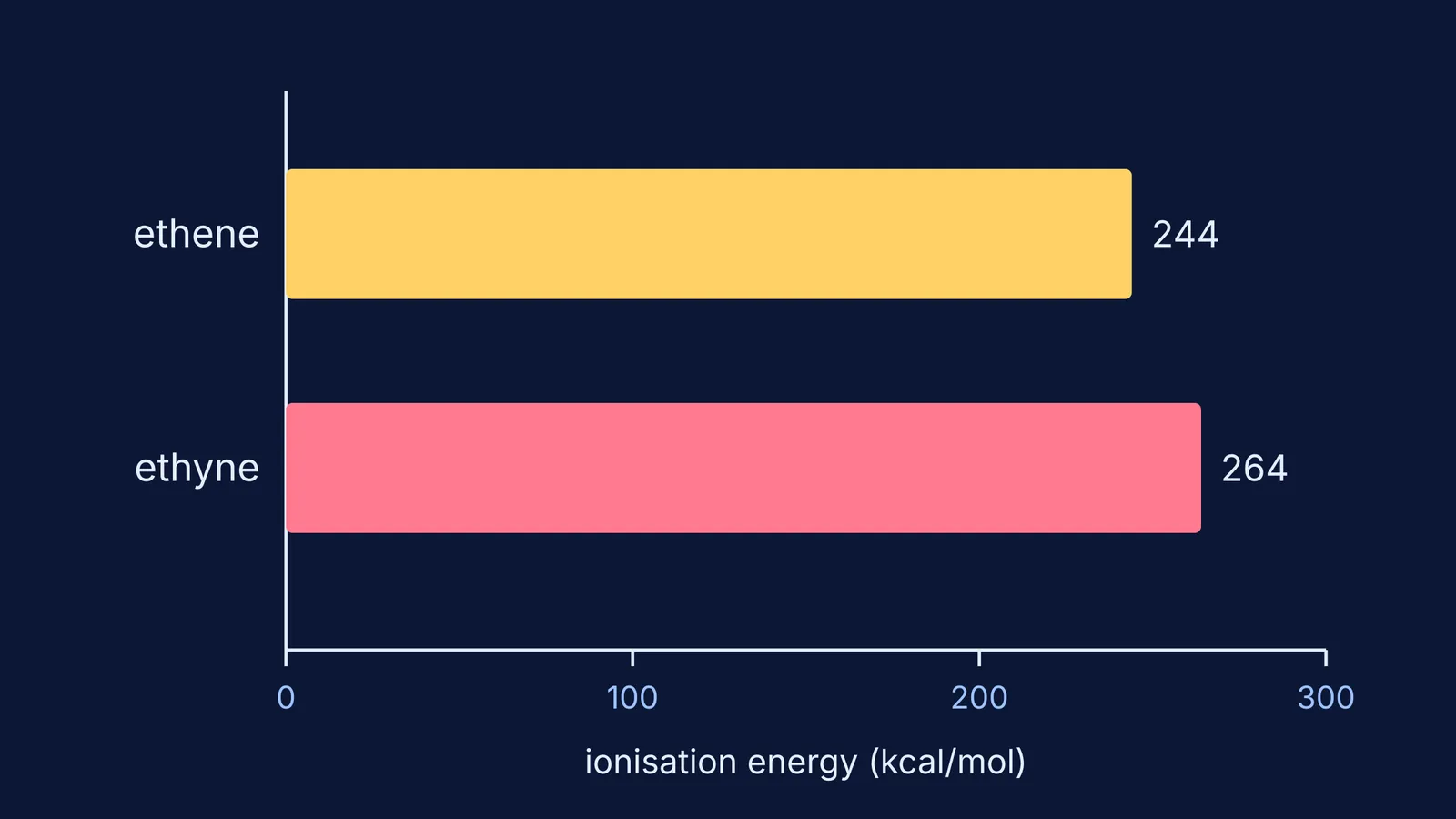
You can see this in measured numbers. The ionisation energy of ethyne is 264 kcal/mol and that of ethene is 244 kcal/mol, according to Reusch's alkyne reactivity page. Pulling an electron out of ethyne costs more, so ethyne is a poorer electron donor to an incoming electrophile.
Reason 2: the intermediate is a vinyl carbocation. When H+ adds to a triple bond, the positive charge lands on a carbon that is still part of a double bond.
What makes a vinyl carbocation so unstable?
A normal carbocation is most stable as a flat sp2 carbon with an empty p orbital. In a vinyl cation the charged carbon is also holding a π bond, so it ends up sp hybridised. Roberts and Caserio put it plainly: the carbocation from the alkyne "cannot achieve the sp² hybrid-orbital configuration expected to be the most stable arrangement for a carbocation" (LibreTexts/10%3A_Alkenes_and_Alkynes_I_-_Ionic_and_Radical_Addition_Reactions/10.06%3A_Electrophilic_Addition_Reactions_of_Alkynes)).
Reusch's page ranks the cations like this: CH3+ ≈ RCH=CH+ < RCH2+ ≈ RCH=CR+ < R2CH+. In words, a primary vinyl cation is about as poor as a methyl cation, and even a secondary vinyl cation only matches a primary alkyl one. Since the slow step of electrophilic addition is making the carbocation, a worse cation means a higher energy barrier and a slower reaction. If you need a refresher on ranking cations, our post on ranking the stability of carbocations, carbanions and free radicals covers hyperconjugation and resonance.
The vinyl cation is unstable enough that Providence College's notes on LibreTexts describe HX addition to alkynes as a termolecular (AdE3) process in which no vinyl carbocation forms.
Why do alkynes react more readily with nucleophiles?
The electron-pulling sp carbons that make alkynes reluctant electron donors make them better electron acceptors. Reusch states that the sp-hybrid carbon atoms of the triple bond "render alkynes more electrophilic than similarly substituted alkenes" (source). His examples: ethyne with potassium ethoxide in ethanol at 150 °C gives ethyl vinyl ether (H2C=CH–OC2H5), and ethyne with HCN and catalytic NaCN gives acrylonitrile (H2C=CH–CN).
Reduction shows another difference. Lindlar's catalyst, palladium on CaCO3 partly poisoned with lead acetate and quinoline, is deactivated so that alkenes are not hydrogenated (Providence College notes). The alkyne is reduced and the product stops at the cis alkene. Sodium in liquid ammonia gives the trans alkene instead.
How do you write this answer in an exam?
Here is a model three-mark answer you can adapt:
In alkynes the triple-bond carbons are sp hybridised (50% s character), so the π electrons are held more tightly than in sp2 alkenes; ethyne's higher ionisation energy shows this.
Electrophilic addition goes through a carbocation. Protonating an alkyne gives a vinyl cation, whose charged carbon cannot become sp2 and is less stable than the alkyl cation formed from an alkene.
The higher energy of this intermediate raises the activation energy, so alkynes add electrophiles more slowly, although they add nucleophiles more readily.
The Markovnikov pattern still applies to alkynes, so review addition to alkenes, Markovnikov's rule and the peroxide effect alongside this. The same 50% s character also explains why terminal alkynes are acidic enough to react with sodamide.
If hybridisation or carbocation stability still feels shaky, the Fermi Concept Library covers every concept in chemistry, each with its own lesson and its place in the map. For practice, the Fermi Problem Library has worked problems with a step-by-step solver that explains the reasoning rather than printing an answer.


