

On this page
When you bubble a gaseous alkene or mix a liquid alkene with cold concentrated sulphuric acid, an electrophilic addition reaction takes place across the carbon-carbon double bond, as documented in Chemguide's guide to alkene additions. The reaction occurs readily at room temperature without heating, producing an alkyl hydrogen sulphate.
Unlike hydration with dilute acid, which introduces a hydroxyl group directly, cold concentrated sulphuric acid acts both as an electrophile and a nucleophile across two distinct mechanical stages.
What happens when an alkene reacts with cold concentrated sulphuric acid?
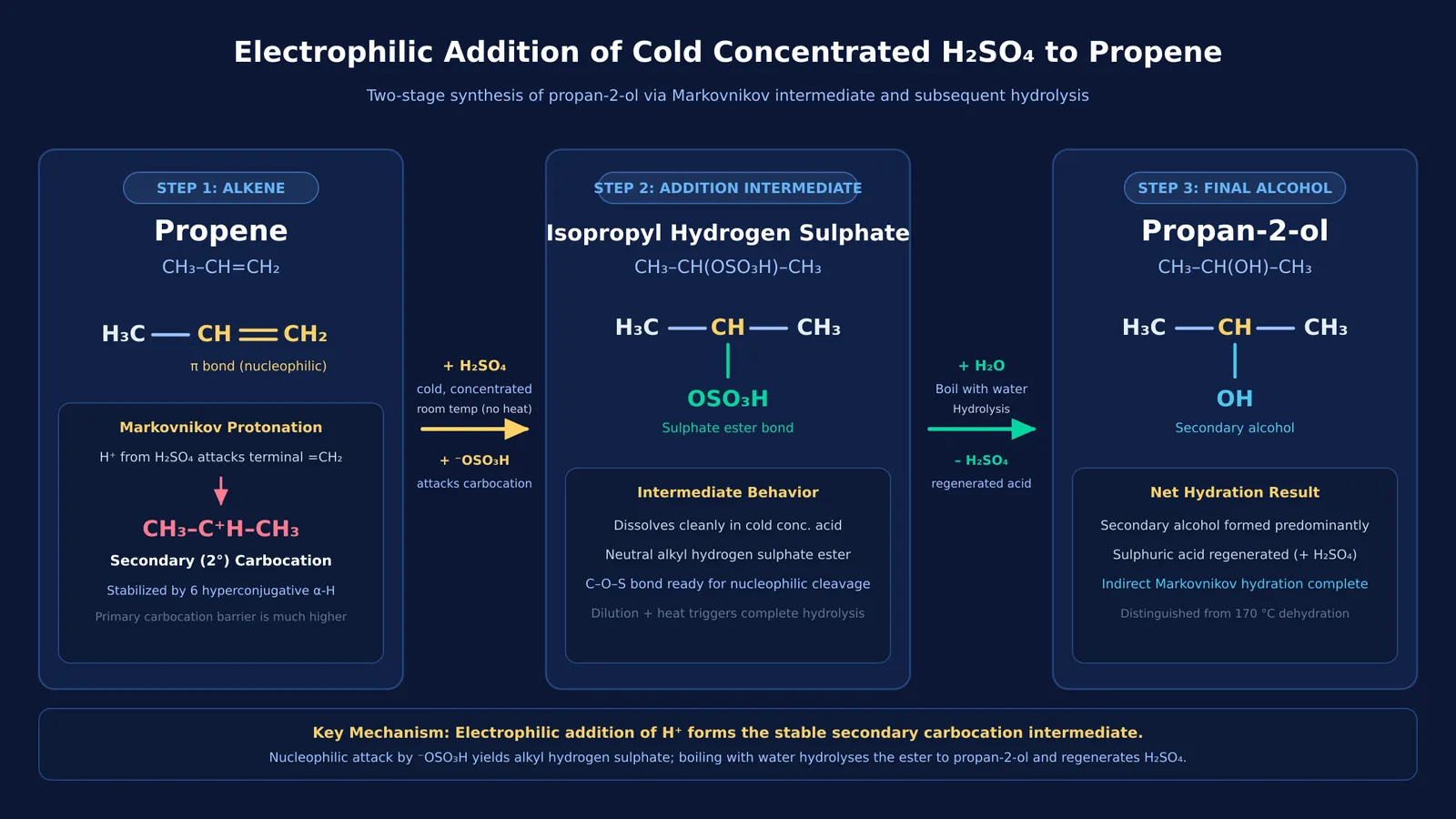
In concentrated sulphuric acid, the strongly polarised H–OSO₃H molecule acts as a source of protons. The electron-rich π bond of the alkene acts as a nucleophile, attacking the partially positive hydrogen atom. This heterolytic cleavage generates a carbocation intermediate alongside a hydrogen sulphate ion (⁻OSO₃H). In the second step, the lone pair on one of the oxygen atoms of the hydrogen sulphate ion rapidly attacks the positively charged carbocation, forming a neutral alkyl hydrogen sulphate.
For symmetrical alkenes such as ethene (CH₂=CH₂), the two doubly bonded carbon atoms are identical, yielding a single addition product:
CH₂=CH₂ + H₂SO₄ → CH₃–CH₂–OSO₃H
Here, ethene converts smoothly into ethyl hydrogen sulphate. According to LibreTexts Chemistry's analysis of alkene additions/Alkenes/Reactivity_of_Alkenes/Addition_of_Sulfuric_acid_to_Alkenes), keeping the acid concentrated and cold prevents competing side reactions, such as polymerisation or premature oxidation.
Why does electrophilic addition follow Markovnikov's rule?
When the reacting alkene is unsymmetrical, such as propene (CH₃–CH=CH₂), the proton can attach to either of the two carbon atoms involved in the double bond. In 1869, Russian chemist Vladimir Vasilyevich Markovnikov formulated the empirical rule that the electrophilic portion of the reagent adds to the carbon with more hydrogen atoms, a foundation reviewed by David E. Lewis in Angewandte Chemie International Edition.
Modern physical organic chemistry explains this regioselectivity through the relative stability of carbocation intermediates, as highlighted by Peter Hughes in the Journal of Chemical Education:
Attack yielding a primary carbocation: If the proton adds to the central carbon (C2), it produces a primary propyl carbocation (CH₃–CH₂–CH₂⁺), which possesses only one adjacent alkyl group providing inductive stabilization.
Attack yielding a secondary carbocation: If the proton adds to the terminal carbon (C1), it produces an isopropyl carbocation (CH₃–CH⁺–CH₃), stabilized by hyperconjugation and inductive electron release from two methyl groups.
Because the secondary carbocation has a substantially lower activation barrier, it forms almost exclusively. The subsequent attachment of the hydrogen sulphate ion occurs at the secondary carbon, producing isopropyl hydrogen sulphate as the dominant product:
CH₃–CH=CH₂ + H₂SO₄ → CH₃–CH(OSO₃H)–CH₃
How does boiling with water convert alkyl hydrogen sulphates to alcohols?
The formation of an alkyl hydrogen sulphate is only the first half of a classic synthetic transformation. When you add water to the alkyl hydrogen sulphate and boil the mixture, the ester undergoes hydrolysis, as described by Chemguide.
During hydrolysis, water acts as a nucleophile, attacking the alkyl carbon and displacing the sulphate group. The overall reaction replaces the –OSO₃H moiety with a hydroxyl (–OH) group and regenerates sulphuric acid:
CH₃–CH(OSO₃H)–CH₃ + H₂O → CH₃–CH(OH)–CH₃ + H₂SO₄
Because the intermediate formed according to Markovnikov's rule, the resulting alcohol is propan-2-ol, a secondary alcohol. Boiling ethyl hydrogen sulphate with water similarly produces ethanol.
Direct hydration versus indirect hydration: what are the key differences?
In industrial chemistry, converting alkenes to alcohols can proceed via two primary routes: indirect hydration via sulphuric acid esters or direct catalytic hydration with steam, as catalogued in Ullmann's Encyclopedia of Industrial Chemistry.
Reagents and conditions: Indirect hydration absorbs alkenes in concentrated sulphuric acid at 95% to 98% concentration under moderate conditions before hydrolysis, whereas direct hydration passes alkene and steam over a solid phosphoric acid catalyst at high temperatures and pressures.
Feedstock purity: Indirect hydration tolerates dilute or unrefined hydrocarbon streams because unreactive alkanes pass through without absorbing into the cold acid. Direct hydration requires high-purity alkene feeds to prevent catalyst poisoning.
Environmental considerations: Direct hydration avoids handling and reconcentrating large volumes of corrosive acid, making it the preferred method for modern large-scale ethanol plants.
How can students master reaction mechanisms for competitive exams?
For students preparing for CBSE examinations, JEE Main, and NEET-UG, electrophilic addition questions often hinge on tracing carbocations and spotting conditions like acid concentration and temperature.
When practicing multi-step reaction conversions, the Fermi Problem Library provides worked problems with a step-by-step solver that explains the reasoning rather than printing an answer.
Connecting addition mechanisms with carbocation stability helps you predict products across a wide variety of functional groups. The Fermi Concept Library covers every concept in physics, chemistry, biology, mathematics and computing, each with its own lesson and its place in the map.
If you struggle to distinguish between direct hydration, indirect hydration, and oxymercuration-demercuration, Fermi's AI tutor can work out what you already know and build a plan for the session, noticing where you get stuck and deciding whether to explain, ask, or show.


