

On this page
Trial and error, which textbooks call balancing by inspection, handles most school equations. It stalls when one element turns up in three or four formulas, because every coefficient you fix knocks another out. The algebraic method swaps guessing for a few equations you can solve.
What is the algebraic method for balancing equations?
A balanced equation has equal numbers of atoms of each element on the reactant and product sides, which the law of conservation of matter requires (OpenStax Chemistry 2e, section 4.1). You may change coefficients but never subscripts, because subscripts define which substance it is (same source).
The algebraic method turns that rule into maths. Pramode Ranjan Bhattacharjee sets out the procedure in The Chemist (2015): give each formula an unknown coefficient, equate the atoms of each element, add a charge equation if ions are present, then solve for the smallest whole numbers. In practice:
Write the skeleton equation and put a letter (a, b, c...) in front of each formula.
For each element, write atoms on the left = atoms on the right. Atoms = coefficient × subscript.
If the equation has ions, add one equation saying total charge on the left = total charge on the right.
Set the letter that appears in the most equations to 1 and solve the rest one by one.
If you get fractions, multiply every coefficient by the smallest number that clears them. Then count every atom once more.
How do you balance KMnO₄ + HCl algebraically?
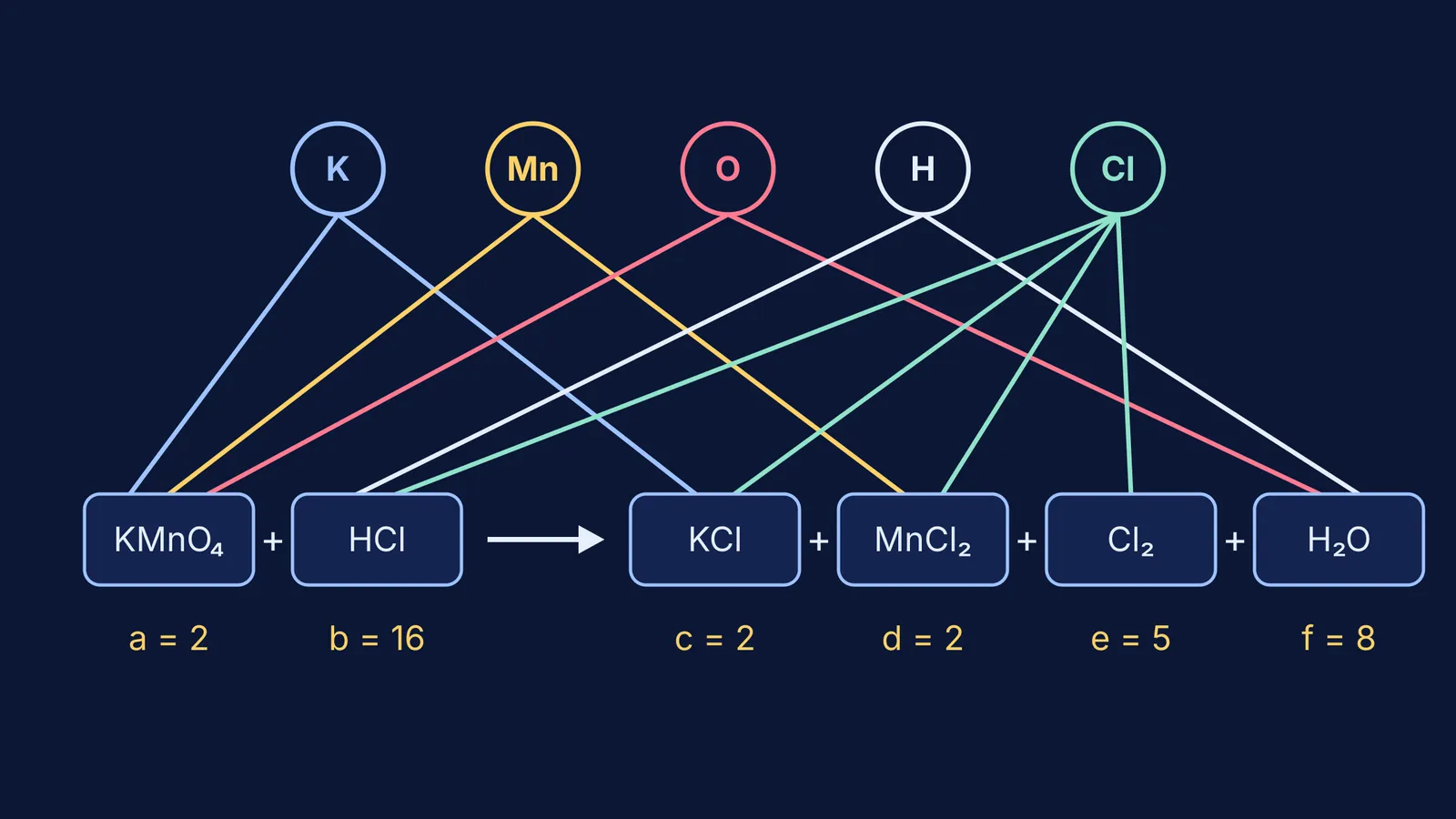
Take a KMnO₄ + b HCl → c KCl + d MnCl₂ + e Cl₂ + f H₂O. There are five elements, so you write five equations:
K: a = c
Mn: a = d
O: 4a = f
H: b = 2f
Cl: b = c + 2d + 2e
Set a = 1. Then c = 1, d = 1 and f = 4, so b = 8. The chlorine line becomes 8 = 1 + 2 + 2e, which gives e = 5/2. Multiply everything by 2:
2KMnO₄ + 16HCl → 2KCl + 2MnCl₂ + 5Cl₂ + 8H₂O
Check chlorine, the hard one: 16 on the left, and 2 + 4 + 10 = 16 on the right. The other four elements match too.
When does the algebraic method beat trial and error?
Use this rule of thumb:
Stay with inspection when each element sits in only one or two formulas. C₃H₈ + O₂ → CO₂ + H₂O falls out quickly: carbon, then hydrogen, then oxygen last.
Switch to algebra when an element appears in three or more formulas, or you have gone round the equation twice without settling.
For ionic redox equations, your syllabus may expect the oxidation-number or half-reaction method, which also shows what is oxidised; see our guide to balancing redox reactions with oxidation numbers and half-reactions. Algebra still makes a fast check.
Before you start, count. Bhattacharjee states in the same paper that the balanced form, with lowest whole-number coefficients, is unique as long as (number of reactants + number of products) − (number of elements) is at most 1. In the KMnO₄ example, 6 − 5 = 1, so by that rule there is only one answer.
Above that count (above 2 for equations with ions, where the charge equation adds a constraint), the paper shows that some equations have infinitely many independent balanced forms. In C + O₂ → CO + CO₂ the count is 4 − 2 = 2, and both 3C + 2O₂ → 2CO + CO₂ and 4C + 3O₂ → 2CO + 2CO₂ are balanced. That usually means two reactions are mixed together, and the question has to give you a ratio.
Does learning the algebraic method help students?
One classroom study suggests it can. Bitwell Chibuye and Kebby Mupela taught one Grade 11 class the algebraic method and another the usual inspection method for four weeks, 81 students in all (Journal of Education and Practice, 2019). The pre-test showed no significant difference between the groups; on the post-test the algebraic class averaged 62.2 against 49.7, a difference significant at p = .006 (same source).
It is one quasi-experiment with two intact classes, so treat it as encouraging rather than settled. Keep both tools: inspection for quick equations, algebra for tangled ones.
Try it: three equations to practise
Fe + H₂O → Fe₃O₄ + H₂ (answer: 3, 4, 1, 4)
Cu + HNO₃ → Cu(NO₃)₂ + NO + H₂O (answer: 3, 8, 3, 2, 4)
C₃H₈ + O₂ → CO₂ + H₂O (answer: 1, 5, 3, 4; try it both ways and time yourself)
For the basics behind these, see balancing chemical equations in Class 10: a method that always works.
If you set up the equations and the numbers still will not come out, the Fermi Problem Library has worked problems with a step-by-step solver that explains the reasoning rather than printing an answer. If the snag is what a subscript counts or why charge must balance, the Fermi Concept Library gives each chemistry concept its own lesson.


