

On this page
Monosaccharides are the simplest carbohydrates, acting as the fundamental building blocks for larger sugars like disaccharides and polysaccharides. When studying biomolecules, you will need to classify them based on two main structural features: the type of carbonyl group they carry and the total number of carbon atoms in their chain. Understanding these categories is the first step to mastering carbohydrate chemistry.
What are monosaccharides?
A monosaccharide is a simple sugar that cannot be hydrolysed into a smaller carbohydrate. By definition, they are either polyhydroxy aldehydes or polyhydroxy ketones (Wikipedia). This means they have a carbon backbone where one carbon forms a double bond with oxygen to create a carbonyl group (C=O), and all the other carbons carry hydroxyl (-OH) groups.
These functional groups give monosaccharides their distinct chemical properties, such as their high solubility in water and their ability to form ring structures. Because they contain multiple chiral centres—carbons bonded to four different groups—monosaccharides also exhibit stereoisomerism. You will often see them labelled as D- or L-isomers based on the orientation of the hydroxyl group on the chiral carbon furthest from the carbonyl group. For example, naturally occurring glucose is the D-isomer.
How are monosaccharides classified as aldose or ketose?
The first part of a sugar's name comes from the position of its carbonyl group within the carbon backbone.
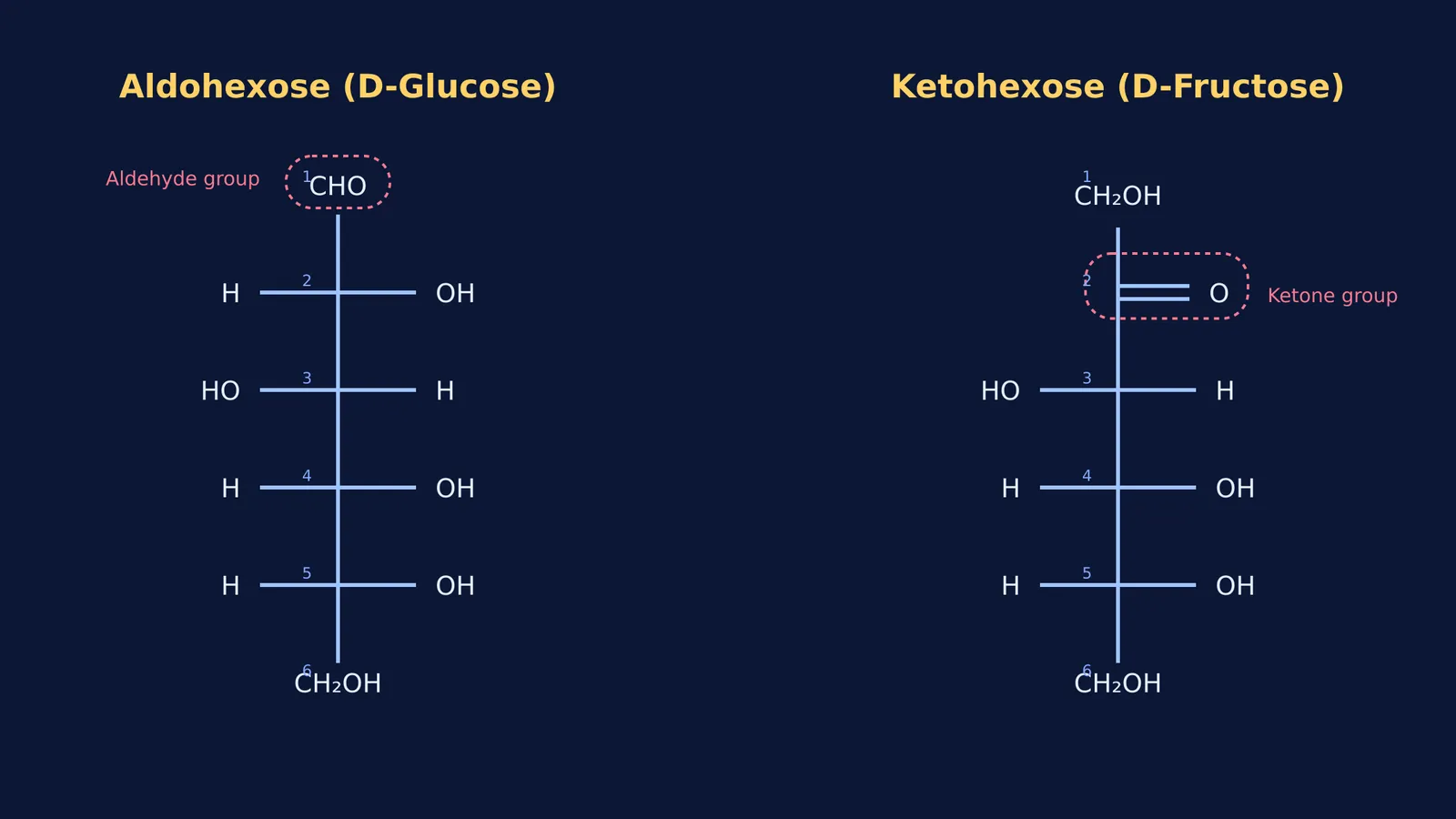
Aldose: If the carbonyl group sits at the very end of the carbon chain (carbon 1), it forms an aldehyde (-CHO). Sugars with this structure take the prefix *aldo-* (Wikipedia).
Ketose: If the carbonyl group is located anywhere else along the chain—typically on the second carbon—it forms a ketone (>C=O). These sugars take the prefix *keto-* (Wikipedia).
This functional group defines much of the sugar's chemical behaviour. For instance, the exposed aldehyde in an aldose makes it a reducing sugar, meaning it can easily donate electrons to other molecules in tests like Tollens' reagent. Ketoses can also act as reducing sugars if they tautomerise into aldoses under basic conditions. You can read more about this mechanism in our guide to reducing and non-reducing sugars.
How do you count carbons for triose, pentose and hexose?
The second part of the classification comes from counting the total carbon atoms in the backbone. The number dictates the suffix of the name:
Triose: 3 carbons.
Tetrose: 4 carbons.
Pentose: 5 carbons.
Hexose: 6 carbons (Wikipedia).
Heptose: 7 carbons.
Sugars with three to seven carbons are the most common in biology, with hexoses and pentoses playing the largest roles in human metabolism and genetics.
Putting it together: why is glucose an aldohexose?
To name a monosaccharide comprehensively, you simply combine the prefix for its carbonyl group with the suffix for its carbon count.
Here is how these combinations work in practice:
Glyceraldehyde has an aldehyde group and 3 carbons. It is an aldotriose.
Dihydroxyacetone has a ketone group and 3 carbons. It is a ketotriose.
Ribose, the sugar that forms the backbone of RNA, has an aldehyde group and 5 carbons. It is an aldopentose.
Glucose, the primary fuel source for our cells, has an aldehyde group and 6 carbons. It is an aldohexose.
Fructose, the main sugar found in fruits, has a ketone group and 6 carbons. It is a ketohexose.
When you first draw out these structures—such as the straight-chain Fischer projections—the rules make immediate visual sense. However, sugars in aqueous solution tend to fold into cyclic forms. The work of Walter Haworth and the ring structures of sugars showed how these linear chains loop back on themselves to form stable rings, which is how they are most often represented in advanced biochemistry.
How can you classify them step by step?
When you face an unfamiliar monosaccharide structure in an exam or assignment, use this simple checklist to name it accurately:
Locate the carbonyl group (C=O). Is it on the terminal carbon (carbon 1)? If yes, write down *aldo-*. If it is on an inner carbon (typically carbon 2), write down *keto-*.
Count the carbons. Number the carbon chain starting from the end closest to the carbonyl group. If the total is 5, write down *pentose*. If 6, write down *hexose*.
Combine the words. For example, an aldehyde on a 5-carbon chain becomes an aldopentose.
If you are stuck on identifying functional groups or classifying organic molecules, the Fermi Concept Library breaks down biomolecules into their structural parts. Fermi's AI tutor can work with you to draw these structures step by step, asking questions to ensure you can reliably spot the difference between an aldose and a ketose. By systematically applying these rules, you can navigate carbohydrate nomenclature without having to memorise the category of every single molecule.


