

On this page
What is the fundamental difference between aldol and Cannizzaro reactions?
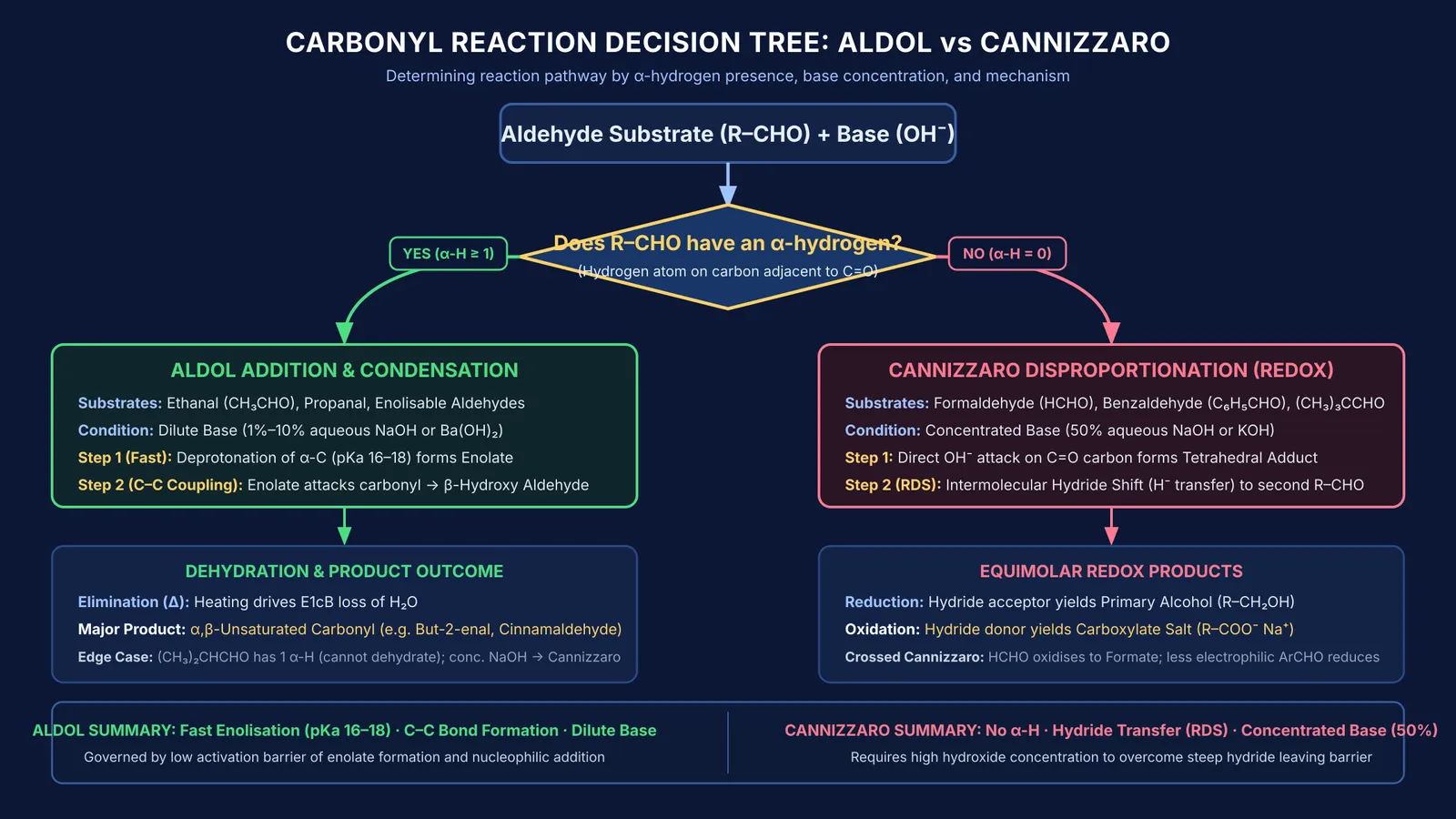
When an aldehyde or ketone encounters a basic solution, two distinct reaction paths can unfold: carbon-carbon bond formation via enolate addition, or redox disproportionation via hydride transfer. Deciding which transformation occurs depends primarily on whether the substrate has hydrogen atoms on the carbon directly adjacent to the carbonyl group (the α-carbon).
Aldehydes with at least one α-hydrogen follow the aldol pathway, first observed during Alexander Borodin's discovery of the aldol reaction. The base abstracts an α-proton to generate an enolate ion, which attacks another aldehyde molecule to form a β-hydroxy aldehyde. Heating this intermediate yields an α,β-unsaturated carbonyl compound.
Conversely, aldehydes lacking α-hydrogens cannot enolise. When exposed to strong base, they undergo the self-redox transformation described in how aldehydes without alpha-hydrogens disproportionate in the Cannizzaro reaction, where one aldehyde molecule is reduced to an alcohol while another is oxidised to a carboxylate salt.
How does the presence of an alpha-hydrogen dictate the reaction path?
The presence of an α-hydrogen directs the reaction because proton removal is kinetically much faster than hydride transfer. The α-hydrogen has a pKa between 16 and 18, so hydroxide establishes a measurable enolate concentration in water. In a kinetic analysis of aldol additions, J. Peter Guthrie showed that enolate formation and carbon-carbon coupling have relatively low intrinsic barriers: J. Am. Chem. Soc. 1991, 113, 19, 7249–7255.
Because enolate formation is so fast, substrates sort immediately by structure:
Enolisable aldehydes (Aldol substrates): Ethanal (CH₃CHO), propanal (CH₃CH₂CHO), and butanal all contain α-hydrogens that readily yield nucleophilic enolates.
Non-enolisable aldehydes (Cannizzaro substrates): Formaldehyde (HCHO), benzaldehyde (C₆H₅CHO), 2,2-dimethylpropanal ((CH₃)₃CCHO), and furfural contain no α-hydrogens.
Without an acidic α-proton to remove, hydroxide cannot form an enolate and must instead attack the carbonyl carbon directly.
Why does aldol use dilute alkali while Cannizzaro requires concentrated base?
Reagent concentration reflects the contrasting activation barriers of these mechanisms. The aldol addition requires only dilute alkali, typically 1% to 10% sodium hydroxide (NaOH) or barium hydroxide (Ba(OH)₂), as outlined in the NCERT Class 12 Chemistry curriculum. Because the base acts catalytically, even a tiny fraction of enolate drives the addition forward.
By contrast, the Cannizzaro reaction requires concentrated alkali, usually 50% aqueous sodium hydroxide. As demonstrated by C. Gardner Swain and colleagues, the rate-determining step is the direct intermolecular transfer of a hydride ion (H⁻) from a tetrahedral adduct to an unreacted aldehyde: J. Am. Chem. Soc. 1979, 101, 13, 3576–3583. Because hydride is an extremely poor leaving group, a high hydroxide concentration is necessary to form sufficient mono- or di-anionic intermediates to force hydride transfer.
Subjecting an enolisable aldehyde like ethanal to 50% concentrated sodium hydroxide does not cause Cannizzaro disproportionation. Instead, it triggers repeated aldol condensations, forming a reddish-brown polymer resin.
How do you predict the major products in crossed reactions?
When two different aldehydes react together in base, substrate reactivity dictates the major outcome:
One enolisable + One non-enolisable aldehyde (Crossed Aldol):
Mixing benzaldehyde (no α-H) and ethanal (three α-H) in dilute sodium hydroxide produces a crossed aldol condensation (Claisen-Schmidt reaction), yielding 3-phenylprop-2-enal (cinnamaldehyde). Ethanal forms the enolate, which attacks benzaldehyde's electrophilic carbonyl. The aldol addition is far faster than Cannizzaro disproportionation.
Two different non-enolisable aldehydes (Crossed Cannizzaro):
Mixing benzaldehyde and formaldehyde with concentrated sodium hydroxide produces benzyl alcohol (C₆H₅CH₂OH) and sodium formate (HCOONa). Formaldehyde is less sterically hindered and more electrophilic, so hydroxide attacks it preferentially. The resulting intermediate transfers hydride to benzaldehyde, oxidising formaldehyde and reducing benzaldehyde.
Two different enolisable aldehydes:
When both partners have α-hydrogens (such as ethanal and propanal), four distinct aldol products form, making the reaction synthetically unselective without specific protecting strategies.
What are the tricky edge cases tested in competitive exams?
Competitive entrance examinations frequently test molecules that seem to defy standard rules:
Isobutyraldehyde ((CH₃)₂CHCHO): This aldehyde has one α-hydrogen and gives an aldol in dilute base. But because its aldol adduct cannot dehydrate and undergoes reversible retro-aldol cleavage, treating it with concentrated sodium hydroxide funnels it into the irreversible Cannizzaro pathway, yielding isobutyl alcohol and sodium isobutyrate.
Trichloroacetaldehyde (Chloral, CCl₃CHO): Although chloral lacks α-hydrogens, treating it with sodium hydroxide yields chloroform (CHCl₃) and sodium formate via haloform cleavage rather than Cannizzaro, because the CCl₃⁻ group is an excellent leaving group.
Benzophenone ((C₆H₅)₂CO): Ketones lacking α-hydrogens do not undergo Cannizzaro reactions because steric hindrance and flanking phenyl rings prevent hydroxide attack and hydride transfer.
Before running these conversions, students often verify carbonyl identity using distinguishing carbonyls with Tollens' and Fehling's tests.
The Fermi Concept Library covers every concept in physics, chemistry, biology, mathematics and computing, each with its own lesson and its place in the map. For multi-step conversions, the Fermi Problem Library provides worked problems with a step-by-step solver that explains the reasoning rather than printing an answer.


