

On this page
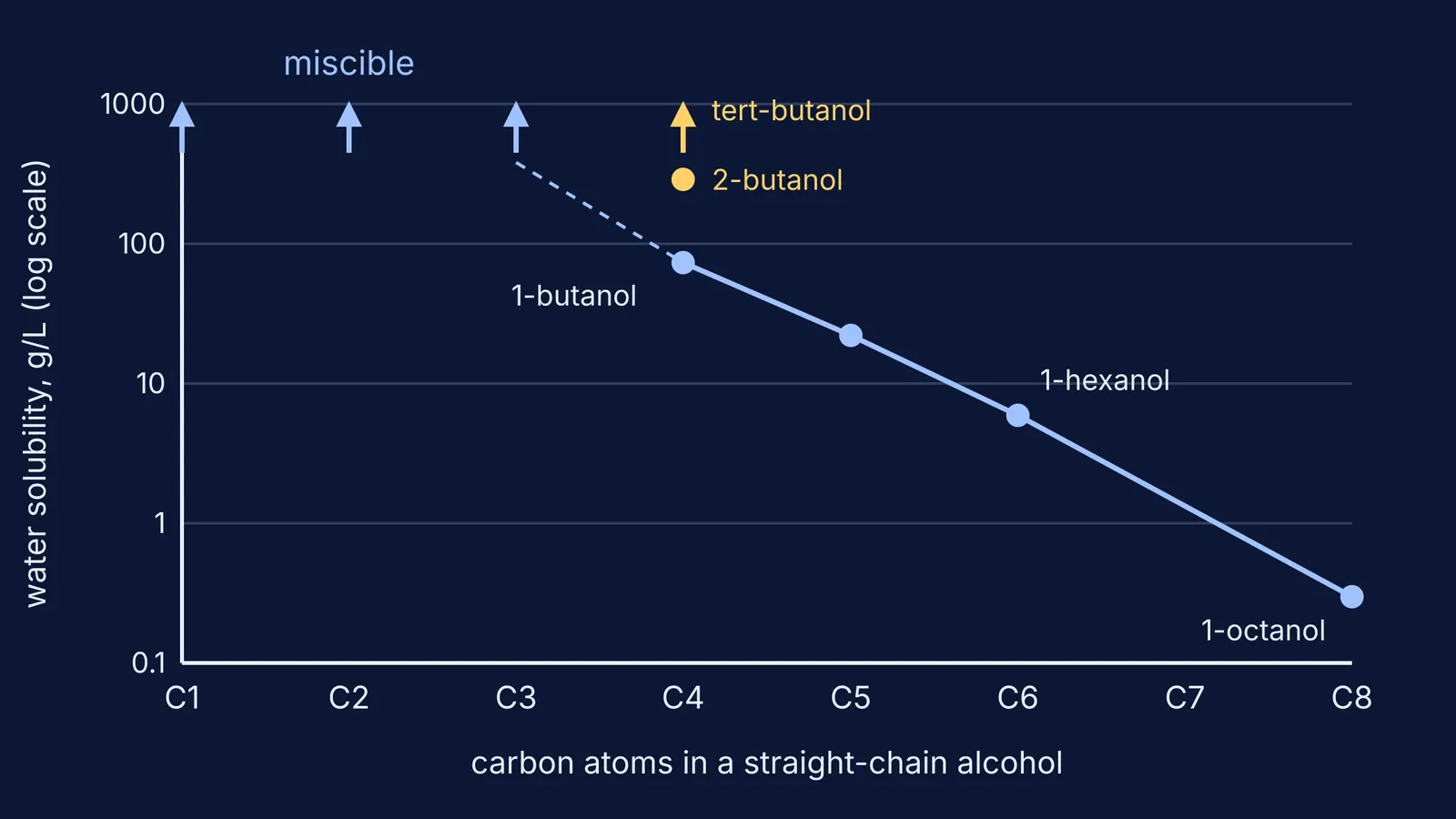
Methanol, ethanol and propan-1-ol mix with water in any proportion. Add one more carbon and things change: butan-1-ol dissolves only to about 73 g per litre at 25 °C, according to its reference data. By octan-1-ol the figure is about 0.3 g per litre (1-octanol data). The reason is a tug of war between two parts of one molecule.
Why does solubility of alcohols decrease with chain length?
Every alcohol has two parts: a polar OH head and a non-polar hydrocarbon tail. The OH head can form hydrogen bonds with water, giving and accepting them just as a water molecule does. That is why the smallest alcohols dissolve so easily.
The tail is the problem. LibreTexts' organic chemistry text_Complete_and_Semesters_I_and_II/Map%3A_Organic_Chemistry_(Wade)/13%3A_Structure_and_Synthesis_of_Alcohols/13.03%3A_Physical_Properties_of_Alcohols) explains that a long hydrocarbon chain is forced in between water molecules, breaking hydrogen bonds between them, and the chain offers only weak van der Waals attraction in return. The same source notes that the drop becomes noticeable at four carbons and beyond.
So each CH2 you add makes the molecule look a little more like an alkane and a little less like water, while the one OH stays the same size. The numbers for straight-chain alcohols show the slide:
Methanol, ethanol, propan-1-ol: miscible (methanol, ethanol, propan-1-ol)
Butan-1-ol: about 73 g/L at 25 °C (data)
Pentan-1-ol: about 22 g/L (data)
Hexan-1-ol: about 5.9 g/L at 20 °C (data)
Octan-1-ol: about 0.3 g/L at 20 °C (data)
From butanol to hexanol, each extra carbon cuts solubility roughly three- to four-fold. Critically evaluated measurements for the C4 alcohols in water are compiled in the IUPAC-NIST Solubility Data Series.
Why are branched alcohols more soluble than straight-chain ones?
Compare the butanols, which all have the formula C4H10O. Butan-1-ol dissolves to about 73 g/L (data). Butan-2-ol dissolves to about 29 g per 100 g of water at 25 °C, several times more (data); many handbooks print a lower, wrong value, so check which figure your textbook uses. 2-Methylpropan-2-ol (tert-butyl alcohol) is fully miscible with water (data).
Branching makes the hydrocarbon part more compact, closer to a ball than a rod. A compact shape has less surface area in contact with water, so less of water's hydrogen-bond network has to be disturbed to fit it in. In an exam answer, write: branching reduces the surface area of the hydrophobic part, so solubility increases.
To tell the C4H10O structures apart, our guide to the four alcohols and three ethers of C4H10O walks through each one.
Are ethers more or less soluble than alcohols?
An ether's oxygen has lone pairs, so it can accept a hydrogen bond from water, even though it has no O-H to donate one. That is enough to give small ethers real solubility. Diethyl ether dissolves to about 6.05 g per 100 mL at 25 °C (diethyl ether data), close to butan-1-ol, its isomer. The LibreTexts chapter on alcohols and ethers/09%3A_Alcohols_Ethers_and_Epoxides/9.12%3A_Physical_Properties) states that an ether has about the same water solubility as the alcohol isomeric with it.
The big difference is boiling point. Ether molecules cannot hydrogen-bond with each other, so diethyl ether boils at 34.6 °C (data) while butan-1-ol boils at 117.7 °C (data). Solubility depends on bonding with water; boiling point depends on bonding with your own kind. For more on that split, read how hydrogen bonding predicts boiling points and solubility.
How do you rank solubility in an exam question?
Use this three-step check on any set of alcohols or ethers:
Count the carbons. A shorter hydrocarbon part means more soluble.
Check branching. Among isomers, the more compact one is more soluble.
Check the oxygen. An ether accepts but cannot donate a hydrogen bond, so treat it as similar to its alcohol isomer for solubility, but much lower for boiling point.
Worked example: rank pentan-1-ol, butan-1-ol, 2-methylpropan-2-ol and propan-1-ol by water solubility. Step 1 puts pentan-1-ol last. Propan-1-ol and 2-methylpropan-2-ol are both miscible; butan-1-ol sits between. Answer: propan-1-ol ≈ 2-methylpropan-2-ol > butan-1-ol > pentan-1-ol, matching the data above. Notice that branching let a four-carbon alcohol catch up with a three-carbon one.
If the idea of a hydrophobic surface still feels abstract, the Fermi Concept Library gives every concept in chemistry its own lesson and its place in the map. To practise give-reasons and ranking questions, the Fermi Problem Library has worked problems with a step-by-step solver that explains the reasoning rather than printing an answer.
For the reactions of these compounds, see our overview of alcohols, phenols and ethers: acidity, key reactions and tests.


