

On this page
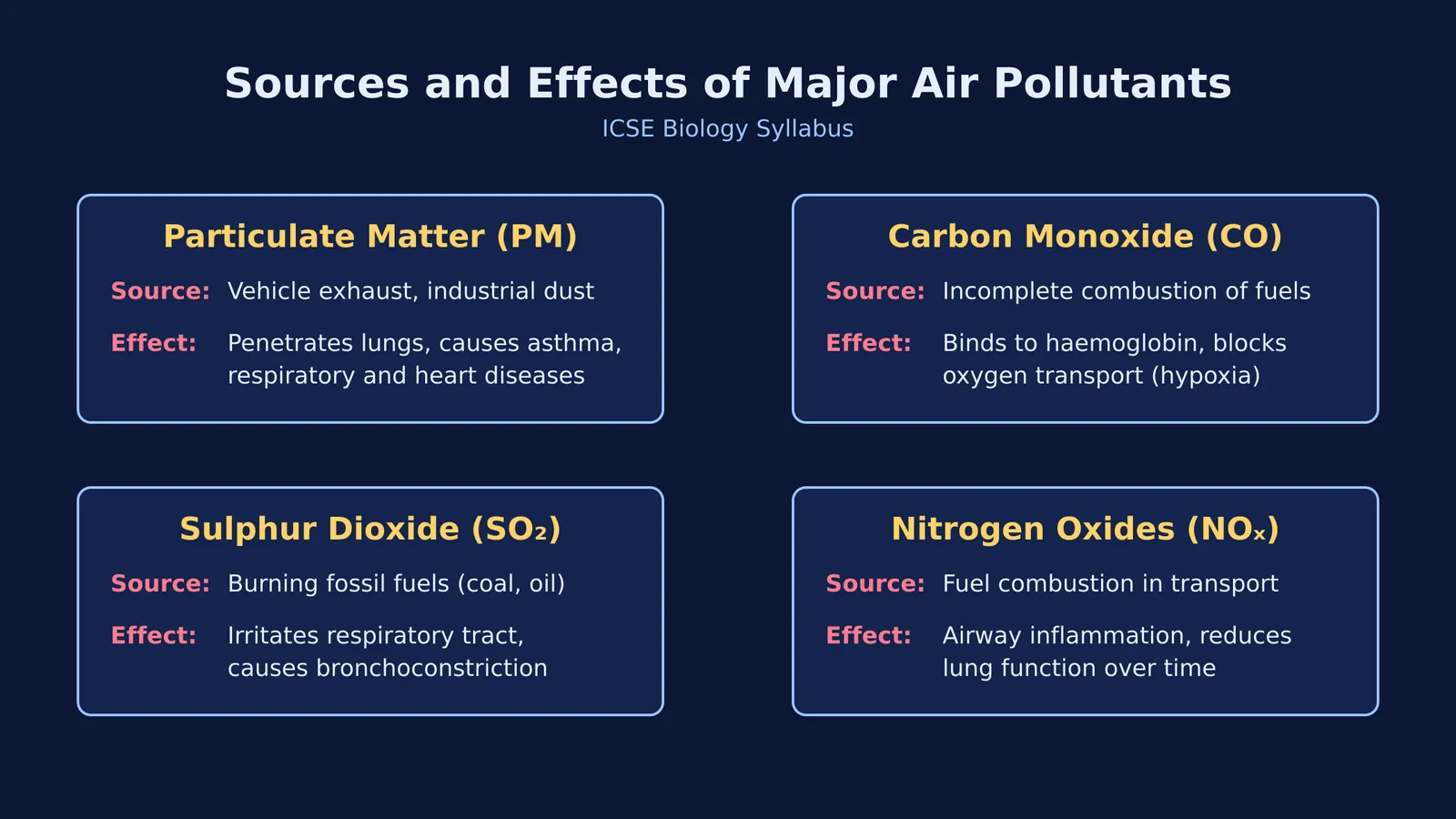
Outdoor air pollution is estimated to cause 4.2 million premature deaths worldwide annually, according to the World Health Organization (WHO)-air-quality-and-health). If you are preparing for your ICSE biology exams, understanding the science behind this global health challenge is essential. The syllabus focuses heavily on four major pollutants: particulate matter, carbon monoxide, sulphur dioxide, and nitrogen oxides.
Knowing where these chemicals come from and exactly how they disrupt the human body is key to answering structured exam questions.
What produces particulate matter and how does it affect the lungs?
Particulate matter (PM) is a complex mixture of solid and liquid droplets suspended in the air. The most dangerous forms are PM₁₀ and PM₂.₅, the latter being so small that they bypass the body's natural defences and penetrate deep into the lungs.
PM is a proxy indicator for air pollution and is primarily released by vehicle exhaust, industrial dust, and burning biomass. Its health impacts are severe: it is the primary cause of pollution-related cardiovascular and respiratory diseases. The WHO states that even low concentrations can be harmful and has set a 24-hour guideline level for PM₂.₅ at 15 µg/m³ [[1]](https://www.who.int/news-room/fact-sheets/detail/ambient-(outdoor)-air-quality-and-health). Chronic exposure aggravates asthma and can lead to lung cancer.
How does carbon monoxide affect the human body?
Carbon monoxide (CO) is a colourless, odourless, and highly toxic gas. It is formed by the incomplete combustion of carbon-based fuels such as petrol, wood, and natural gas.
When you inhale CO, it crosses into your bloodstream and binds to haemoglobin much more effectively than oxygen does, creating a stable compound called carboxyhaemoglobin. This blocks red blood cells from carrying oxygen to vital organs, leading to oxygen deprivation. The historical discovery of this mechanism forms the basis of many biological safety practices, tracing back to researchers like J. S. Haldane, carbon monoxide and the animals that warned miners. To protect public health, the WHO limits 24-hour exposure to 4 mg/m³ [[1]](https://www.who.int/news-room/fact-sheets/detail/ambient-(outdoor)-air-quality-and-health).
What are the main sources of sulphur dioxide and nitrogen oxides?
Sulphur dioxide (SO₂) and nitrogen oxides (NOₓ) are primary components of industrial smog and both cause significant respiratory distress.
Sulphur dioxide is mainly produced from burning sulphur-containing fossil fuels like coal and oil, as well as during the smelting of mineral ores. It is a colourless gas with a sharp odour that causes immediate irritation of the respiratory tract, leading to bronchoconstriction—a sudden narrowing of the airways that triggers asthma attacks. The WHO sets a strict 24-hour guideline for SO₂ at 40 µg/m³ [[1]](https://www.who.int/news-room/fact-sheets/detail/ambient-(outdoor)-air-quality-and-health).
Nitrogen dioxide (NO₂), a prominent nitrogen oxide, is released primarily from fuel combustion in the transport and industrial sectors. Breathing NO₂ causes inflammation of the airways, reduces lung function, and makes the respiratory system more vulnerable to acute infections.
A revision framework for air pollutants
When studying these environmental topics for ICSE biology, memorising isolated facts can be difficult. Instead, build a simple table that maps the source to the physiological effect.
Here is a quick framework you can recreate in the exam hall:
Pollutant: Write the formula (e.g., CO).
Primary Source: Note the main human activity (e.g., incomplete combustion).
Physiological Action: Trace the chemical interaction (e.g., binds to haemoglobin).
Clinical Effect: Name the disease or symptom (e.g., hypoxia, asthma).
Understanding how chemical pollutants interact with human anatomy requires connecting environmental science with your knowledge of Class 10 life processes: nutrition, respiration, transport, excretion. If you want to check your understanding of these pathways before the exam, the Fermi Concept Library covers every concept in physics, chemistry, biology, mathematics and computing, and can help you trace these respiratory effects step by step. You can also explore related topics like Biological magnification: how pesticides build up, Class 10 to see how chemical compounds accumulate through ecosystems.


