

On this page
When you study probability, the addition theorem for two events — P(A ∪ B) = P(A) + P(B) − P(A ∩ B) — is often one of the first formulas you learn. But in real-world scenarios, such as tracking student performance across Mathematics, Physics, and Chemistry, you frequently need to combine three sets of outcomes.
Finding the probability of at least one of three events happening requires expanding that logic to account for multiple overlaps without counting the same students twice.
What is the probability of A or B or C formula?
The probability of the union of three events (A, B, or C) is found using the addition theorem, which states P(A ∪ B ∪ C) = P(A) + P(B) + P(C) − P(A ∩ B) − P(A ∩ C) − P(B ∩ C) + P(A ∩ B ∩ C) [[Wolfram MathWorld]](https://mathworld.wolfram.com/Inclusion-ExclusionPrinciple.html).
This gives you the chance that at least one of the three events will occur.
Why do we add and subtract?
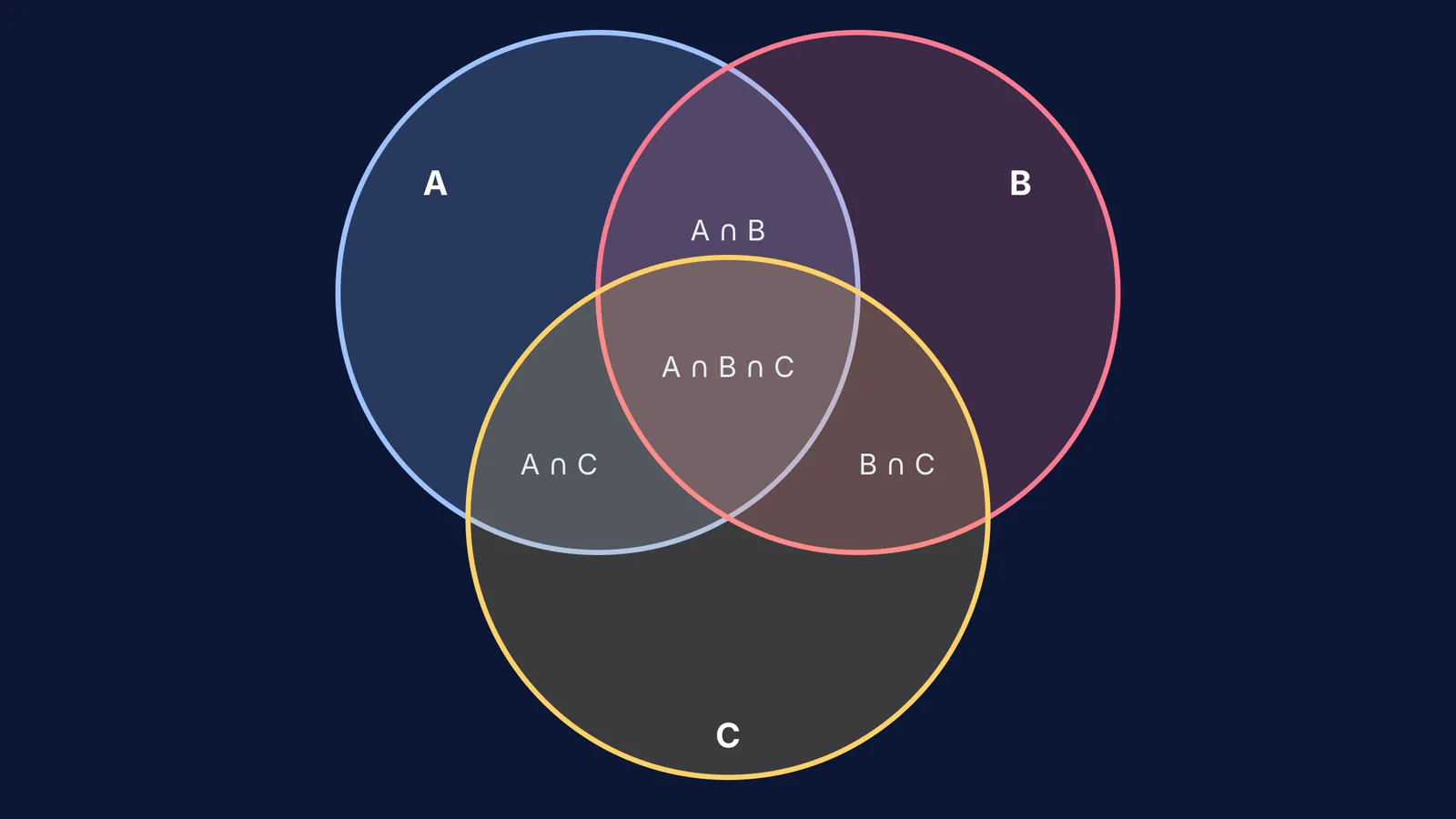
If you simply added P(A) + P(B) + P(C), you would be double-counting any outcomes where two events overlap. To get an accurate probability, we build the formula in three distinct steps:
Inclusion of single events: We start by adding the probabilities of each individual event: P(A) + P(B) + P(C).
Exclusion of pairs: We subtract the probabilities of the pairwise intersections: P(A ∩ B), P(A ∩ C), and P(B ∩ C). We do this because the overlap between any two circles in a Venn diagram was counted twice in the first step, so we must remove the excess.
Inclusion of the triple overlap: When we subtracted all three pairs, we also subtracted the very centre overlap—P(A ∩ B ∩ C)—three times. Since it was added three times in step 1 and subtracted three times in step 2, it currently is not counted at all. We add it back once at the end so those students are included.
This structured adding and subtracting is the core of Three-set Venn problems: counting with inclusion-exclusion.
How do you translate word problems into the formula?
When you face a probability question in an exam, the hardest part is often figuring out which numbers correspond to which terms in the formula. Here is a quick translation guide:
"Passed Mathematics" is P(A). It includes students who *only* passed Mathematics, as well as those who passed it alongside other subjects.
"Passed both Physics and Chemistry" is P(B ∩ C).
"Passed all three subjects" is P(A ∩ B ∩ C).
"Passed at least one subject" is the final union we are solving for: P(A ∪ B ∪ C).
"Failed all three subjects" is the exact opposite of the union. You find it by calculating 1 − P(A ∪ B ∪ C).
How do you calculate a three-subject pass rate?
To see this principle in action, let us look at a practical Class 12 exam scenario. In 2024, the overall CBSE Class 12 pass percentage was 87.98% [[India Today]](https://www.indiatoday.in/education-today/news/story/cbse-board-12th-result-2024-out-at-cbseresultsnicin-8798-pass-percentage-recorded-2538421-2024-05-13).
If we look closely at a hypothetical batch of 100 science students, we can track their pass rates across Mathematics (M), Physics (P), and Chemistry (C). Imagine the historical data gives us these exact probabilities for a student passing:
Single subjects: P(M) = 0.60, P(P) = 0.57, P(C) = 0.50
Two subjects: P(M ∩ P) = 0.35, P(M ∩ C) = 0.30, P(P ∩ C) = 0.32
All three subjects: P(M ∩ P ∩ C) = 0.20
What is the probability that a student picked at random passed *at least one* of these three subjects?
We apply the addition theorem by slotting our values into the formula: P(M ∪ P ∪ C) = 0.60 + 0.57 + 0.50 − 0.35 − 0.30 − 0.32 + 0.20
Breaking the calculation down into steps:
Sum of singles: 1.67
Sum of pairs: 0.97
Triple intersection: 0.20
P(M ∪ P ∪ C) = 1.67 − 0.97 + 0.20 = 0.90
So, the probability that a student passed Mathematics, Physics, or Chemistry is 0.90 (or 90%). Consequently, the probability of failing all three is simply 1 − 0.90 = 0.10. Solving problems like this systematically reduces mistakes compared to trying to count populations by hand, just as it does in with and without replacement probability.
Where do students go wrong?
The most common mistake when applying the addition theorem to three events is forgetting the final term: adding back the central overlap. Without P(A ∩ B ∩ C), your final probability will be artificially low, and in some numerical problems, it might even result in a negative number for a specific subset region.
If complex equations leave you unsure of your next step, the Concept Library contains every concept in physics, chemistry, biology, mathematics and computing, each with its own lesson and its place in the map. For practice, the Fermi Problem Library has worked problems with a step-by-step solver that explains the reasoning rather than printing an answer. When you get stuck, Fermi's AI tutor can work out what you already know and build a plan for the session, so you sit down to a clear next step instead of a blank page.


