

On this page
When you mix pure acetone and pure chloroform, the container gets noticeably warm. This is a classic example of an exothermic process where the enthalpy of mixing (ΔH) is negative. It is a mandatory practical experiment in the CBSE Class 12 chemistry syllabus and a frequent case study in thermodynamics and solutions for JEE and NEET.
Why does mixing acetone and chloroform release heat?
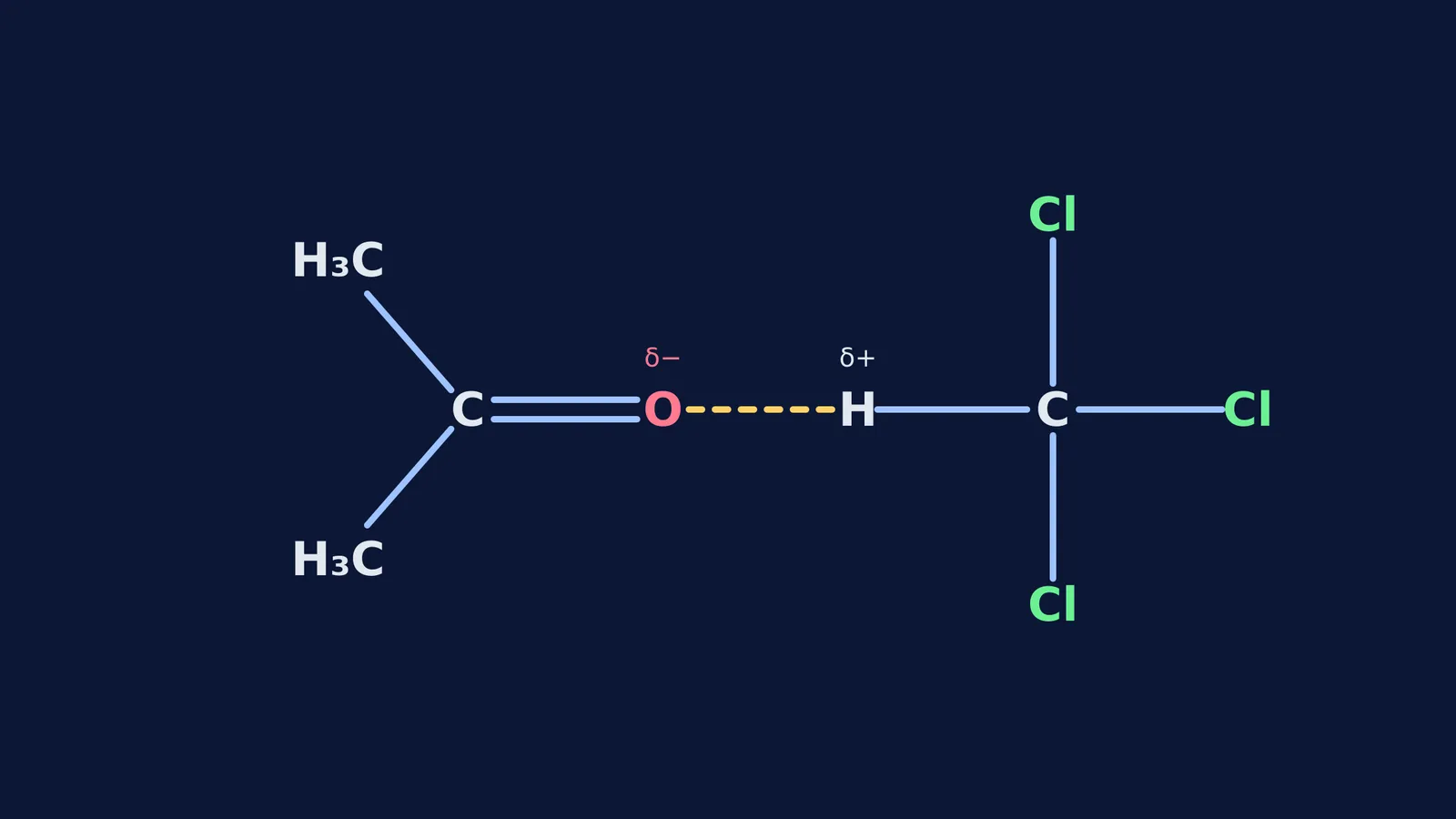
In their pure states, acetone (CH₃COCH₃) molecules are held together by dipole-dipole interactions, while chloroform (CHCl₃) molecules interact through weaker dispersion forces.
When you mix the two, a strong intermolecular hydrogen bond forms. The three highly electronegative chlorine atoms in chloroform pull electron density away from the carbon atom, which in turn leaves the single hydrogen atom electron-deficient and highly positive. This acidic hydrogen is strongly attracted to the lone pairs on the oxygen atom of acetone's carbonyl group.
Because these new acetone-chloroform (A-B) interactions are stronger than the original acetone-acetone (A-A) and chloroform-chloroform (B-B) bonds, the system moves to a lower energy state. The excess energy is released as heat. In 1960, researchers measured the specific energy of this C-H···O hydrogen bond to be 11.3 kJ/mol (2.7 kcal/mol). This strong bond makes the macroscopic enthalpy of mixing negative.
What is the enthalpy change on mixing acetone and chloroform practical?
The standard Class 12 practical measures this heat release using a simple calorimeter (often an insulated polythene bottle). The goal is to record the maximum temperature rise when equal volumes of the two liquids are mixed.
Find the baseline: Measure a set volume (e.g., V mL) of acetone into the calorimeter. Note its initial temperature (t₁). Measure an equal volume of chloroform separately and ensure it is at the exact same temperature.
Mix and measure: Quickly pour the chloroform into the acetone, seal the calorimeter, and stir gently. As the hydrogen bonds form, the temperature will rise. Record the highest temperature reached (t₂).
Calculate the heat: The heat evolved (Q) warms the liquids and the calorimeter itself.
You can calculate Q using the specific heat capacities (s) and masses (m) of the liquids:
Mass = Volume × Density
Q = [W + (m₁s₁) + (m₂s₂)] × (t₂ - t₁)
Here, W is the water equivalent of the calorimeter (in J/K). Since the temperature goes up (t₂ > t₁), heat is released, making the enthalpy change negative (ΔH = −Q). If you are preparing for exams, you might also need to know how to calculate energy changes in sealed environments, such as a bomb calorimeter measuring ΔU.
Working through solution thermodynamics?
Understanding non-ideal solutions requires keeping track of intermolecular forces, vapour pressures, and energy changes. If you are reviewing these ideas for your board exams or competitive tests, the Fermi Concept Library breaks down Raoult's Law and its deviations step by step.
If you get stuck on a calculation—whether it is finding the final enthalpy or mixing and diluting solutions to find molarity—Fermi's AI tutor can help. Instead of just printing an answer, the tutor works out what you already know and builds a plan for the session, guiding you through the reasoning so you can solve the next one on your own.


