

On this page
This identity looks heavy, but it does two simple jobs: it factorises long cubic expressions in one line, and, when three numbers add to zero, it lets you add their cubes without cubing anything. Here is how to spot it and avoid the sign slips that cost marks.
What is the a³ + b³ + c³ − 3abc identity?
The identity is a³ + b³ + c³ − 3abc = (a + b + c)(a² + b² + c² − ab − bc − ca), and it is listed in the CBSE Mathematics syllabus for Classes IX-X, 2025-26, alongside the other cubic identities and "their use in factorization of polynomials".
In the CBSE Class IX Mathematics syllabus for 2026-27, identities get their own chapter, Exploring Algebraic Identities, in an Algebra unit worth 20 of the 80 marks. The new Ganita Manjari book's Chapter 4 exercise still asks you to factorise p³ + 27q³ + r³ − 9pqr (Extramarks Chapter 4 solutions). Our guide to the new CBSE Class 9 books covers the other changes.
Multiply out the right-hand side and every cross term such as a²b cancels, leaving a³ + b³ + c³ − 3abc. A second form is easier to remember:
a³ + b³ + c³ − 3abc = ½(a + b + c)[(a − b)² + (b − c)² + (c − a)²]
Why does a + b + c = 0 make it so easy?
If a + b + c = 0, the first bracket is zero, so the whole right-hand side is zero. That leaves a³ + b³ + c³ − 3abc = 0, which means a³ + b³ + c³ = 3abc.
The half-form adds one more fact for real numbers: if a³ + b³ + c³ = 3abc, then either a + b + c = 0 or a = b = c.
How do you evaluate cubes without calculating them?
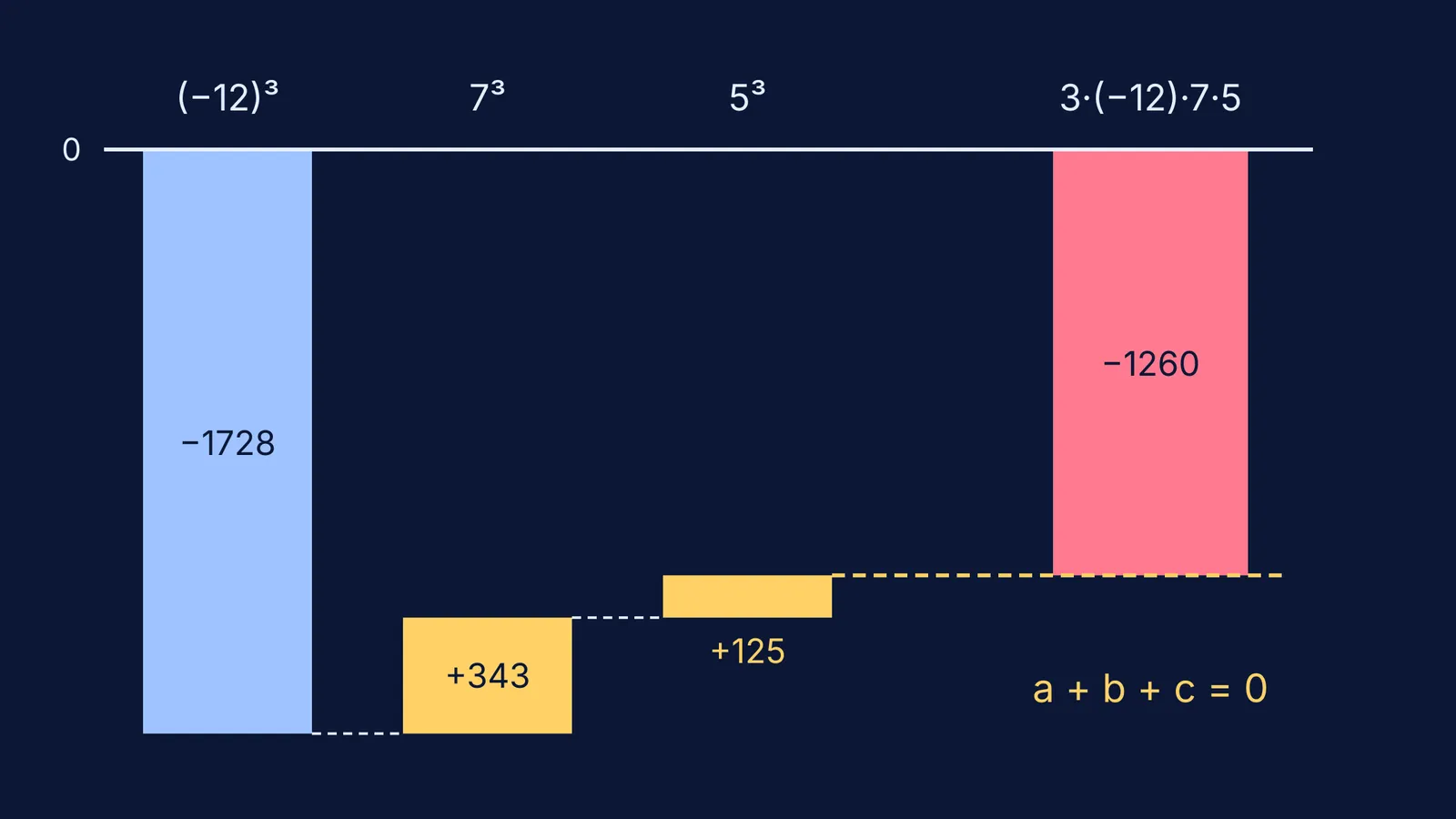
The older NCERT Polynomials chapter, Exercise 2.4, asks you to evaluate (−12)³ + 7³ + 5³ and (28)³ + (−15)³ + (−13)³ without finding the cubes; you can see the questions in this Exercise 2.4 solution set.
Add the bases: −12 + 7 + 5 = 0.
So the answer is 3 × (−12) × 7 × 5 = −1260.
Check once by brute force: −1728 + 343 + 125 = −1260.
For the second, 28 − 15 − 13 = 0, so the sum is 3 × 28 × (−15) × (−13) = 16380. Two minus signs make the product positive.
The same idea works with letters. For (x − y)³ + (y − z)³ + (z − x)³, the three brackets add to zero, so the answer is 3(x − y)(y − z)(z − x) with no expansion at all.
How do you factorise expressions like 27x³ + y³ + z³ − 9xyz?
Use this three-step routine every time:
Write each cube term as something cubed: 27x³ = (3x)³, so a = 3x, b = y, c = z.
Check the last term: 3abc = 3(3x)(y)(z) = 9xyz. It matches, so the identity applies.
Substitute: (3x + y + z)(9x² + y² + z² − 3xy − yz − 3zx).
The NCERT worked example on factorising 8x³ + y³ + 27z³ − 18xyz uses a = 2x, b = y and c = 3z, giving (2x + y + 3z)(4x² + y² + 9z² − 2xy − 3yz − 6xz).
Now try one with signs: x³ − 8y³ − 27z³ − 18xyz. Take a = x, b = −2y, c = −3z. Then 3abc = 3(x)(−2y)(−3z) = 18xyz, which matches. The factors are (x − 2y − 3z)(x² + 4y² + 9z² + 2xy − 6yz + 3zx). Notice how −ab = −(x)(−2y) becomes +2xy.
What mistakes cost marks on this identity?
Plus signs on ab, bc and ca in the second bracket. They are all minus.
Skipping the 3abc check. With −6xyz instead of −9xyz, 27x³ + y³ + z³ does not fit.
Writing 8x³ as (8x)³ instead of (2x)³.
Cubing numbers whose bases add to zero.
Writing (−2y)² as −4y². It is +4y².
If a step keeps going wrong, the Fermi Problem Library has worked problems with a step-by-step solver that explains the reasoning rather than printing an answer, so you can see where the sign flipped. If the gap is further back, the Fermi Concept Library gives each mathematics concept its own lesson.
This identity builds on the square and cube identities from algebraic identities in Class 8, and it pairs well with the factor theorem in polynomials in Class 9. Redo the worked examples above without looking, then check each factorisation by putting in small numbers such as x = 1, y = 2, z = 3.


