

On this page
In short
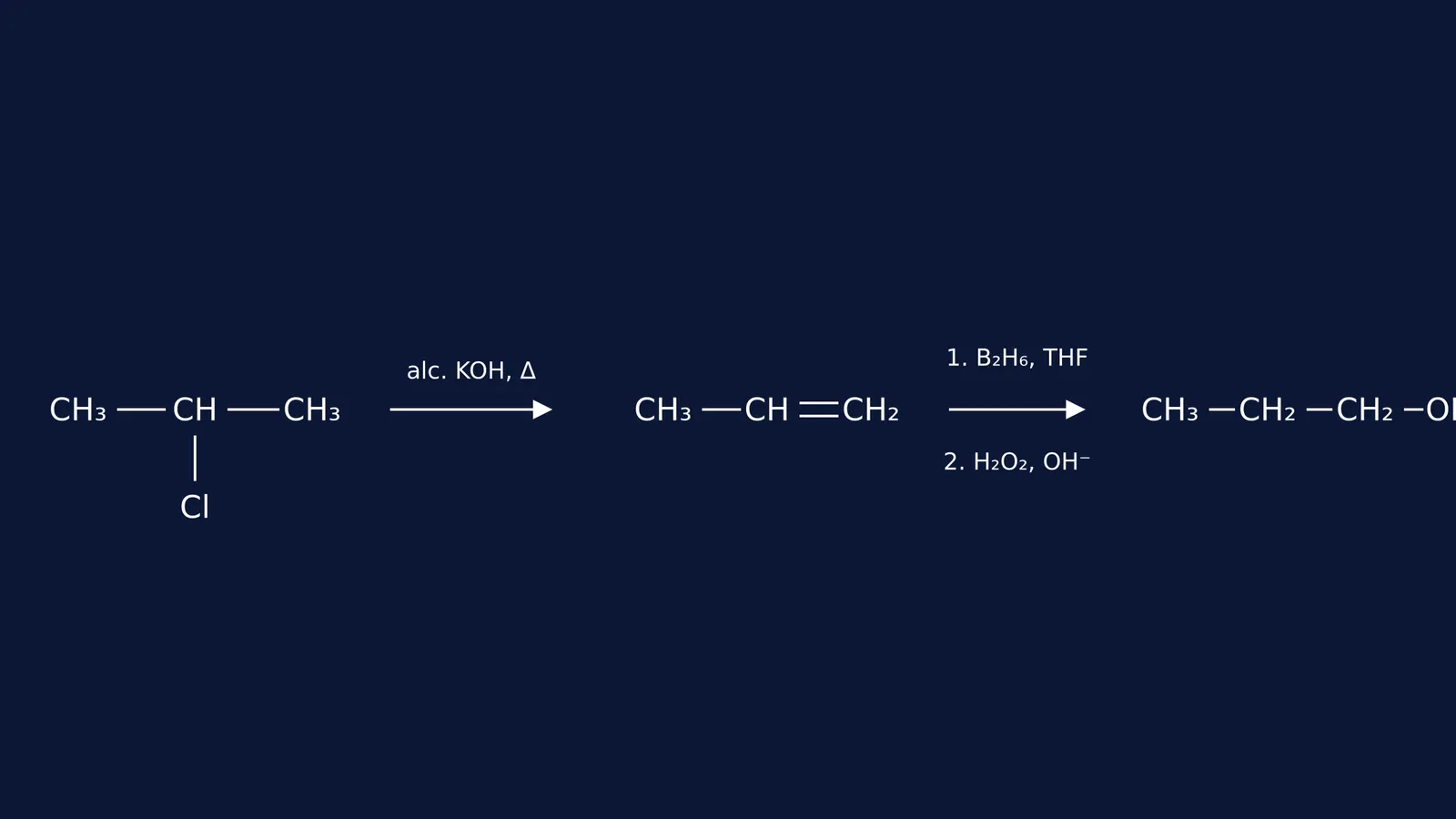
Converting 2-chloropropane to propan-1-ol requires moving the functional group from the middle carbon to the end. First, heating with alcoholic KOH eliminates hydrogen chloride to give propene (Hughes and Ingold, 1941). Then, hydroboration-oxidation adds water across the double bond in an anti-Markovnikov manner to yield propan-1-ol (Brown and Subba Rao, 1959).
When you need to turn a secondary haloalkane like 2-chloropropane into a primary alcohol like propan-1-ol, you cannot do it in one direct step. A direct substitution with aqueous potassium hydroxide would simply swap the chlorine for a hydroxyl group on the same carbon, leaving you with propan-2-ol. To shift the functional group to the end of the carbon chain, you must first create a double bond and then add water against Markovnikov's rule.
If you are mapping out reaction pathways like this, the Fermi Concept Library holds every concept in physics, chemistry, biology, mathematics and computing, each with its own lesson and its place in the map.
How do you eliminate 2-chloropropane to propene?
The first step is dehydrohalogenation. When you heat 2-chloropropane with a strong, bulky base such as alcoholic KOH, the reaction path shifts away from substitution and toward elimination.
The choice of solvent here is critical. In an aqueous solution, the hydroxide ion is highly hydrated and acts as a nucleophile, leading to a substitution reaction. However, in an alcoholic solution (like ethanol), the strong base generates alkoxide ions (such as ethoxide). These are stronger bases and less solvated, so they prefer to pull a proton (H⁺) from one of the adjacent methyl groups rather than attacking the central carbon.
As the proton is removed, the chloride ion leaves from the central carbon. The E2 mechanism for this one-step concerted elimination was detailed by Hughes and Ingold in 1941. Because the base removes a proton and the leaving group departs simultaneously, there is no carbocation intermediate to rearrange.
Because 2-chloropropane is symmetrical, losing a proton from either terminal carbon gives the exact same product: propene.
Equation:
CH₃–CH(Cl)–CH₃ + KOH (alc) + Δ → CH₃–CH=CH₂ + KCl + H₂O
How do you convert propene to propan-1-ol?
Now you have propene, an alkene. Adding water directly using acid catalysis would follow Markovnikov's rule. The hydrogen would attach to the terminal carbon (which already has more hydrogens), placing the OH group on the central carbon to give propan-2-ol again. To get the primary alcohol, you need an anti-Markovnikov addition.
The standard way to achieve this is hydroboration-oxidation, a reaction discovered by Brown and Subba Rao in 1959.
This is a two-stage process. In the first stage, diborane (B₂H₆) in tetrahydrofuran (THF) adds to the double bond. Boron is less electronegative than hydrogen, so it acts as the electrophile and attaches to the less hindered terminal carbon. The transition state is a four-membered ring where the boron and hydrogen add to the same face of the alkene (a syn addition). This step happens three times until all the boron-hydrogen bonds are replaced by alkyl groups, forming tripropylborane.
In the second stage, oxidation with hydrogen peroxide (H₂O₂) in an alkaline medium (OH⁻) replaces the boron atom with a hydroxyl group. The oxidation retains the stereochemistry of the first step. Because the boron originally attached to the terminal carbon, the OH group also ends up there.
Equation:
6 CH₃–CH=CH₂ + B₂H₆ → 2 (CH₃–CH₂–CH₂)₃B
(CH₃–CH₂–CH₂)₃B + 3 H₂O₂ + OH⁻ → 3 CH₃–CH₂–CH₂–OH + B(OH)₄⁻
The overall result is the addition of water (H and OH) across the double bond without any carbocation rearrangements, cleanly yielding propan-1-ol.
If you are looking for how alcohols react in the other direction, the route is different. Removing water from a primary alcohol often involves a carbocation intermediate and can lead to different products; see our guide on the dehydration of alcohols and the major alkene formed.
Can you use the peroxide effect instead?
Another valid route to move the functional group to the terminal carbon uses the peroxide effect, also known as the Kharasch addition. After eliminating 2-chloropropane to propene, you can add hydrogen bromide (HBr) in the presence of an organic peroxide.
Under normal conditions, adding HBr to propene follows Markovnikov's rule to give 2-bromopropane. However, when peroxides are present, they initiate a free radical mechanism. This changes the regiochemistry, leading to an anti-Markovnikov addition. The bromine atom attaches to the terminal carbon, yielding 1-bromopropane as the major product.
Once you have 1-bromopropane, you have successfully moved the halogen to the primary position. The final step is a simple nucleophilic substitution. By heating 1-bromopropane with aqueous potassium hydroxide (aq. KOH), the hydroxide ion displaces the bromide ion, yielding propan-1-ol. While hydroboration-oxidation is often preferred for its clean, high-yield conversion without rearrangement in two steps, the peroxide route is a completely acceptable three-step alternative for exam conversions.
What is the complete reaction sequence?
When solving conversion problems in an exam, it helps to write out the full sequence linearly. The conversion of 2-chloropropane to propan-1-ol is a classic example of moving a functional group from a secondary to a primary position.
CH₃–CH(Cl)–CH₃ (2-chloropropane)
Add KOH (alc), Δ
Forms CH₃–CH=CH₂ (propene)
Add B₂H₆/THF, then H₂O₂, OH⁻
Forms CH₃–CH₂–CH₂–OH (propan-1-ol)
By mastering these two reliable tools—elimination to form a double bond and anti-Markovnikov hydration to place the hydroxyl group—you can tackle a wide range of organic conversions with confidence.


