

On this page
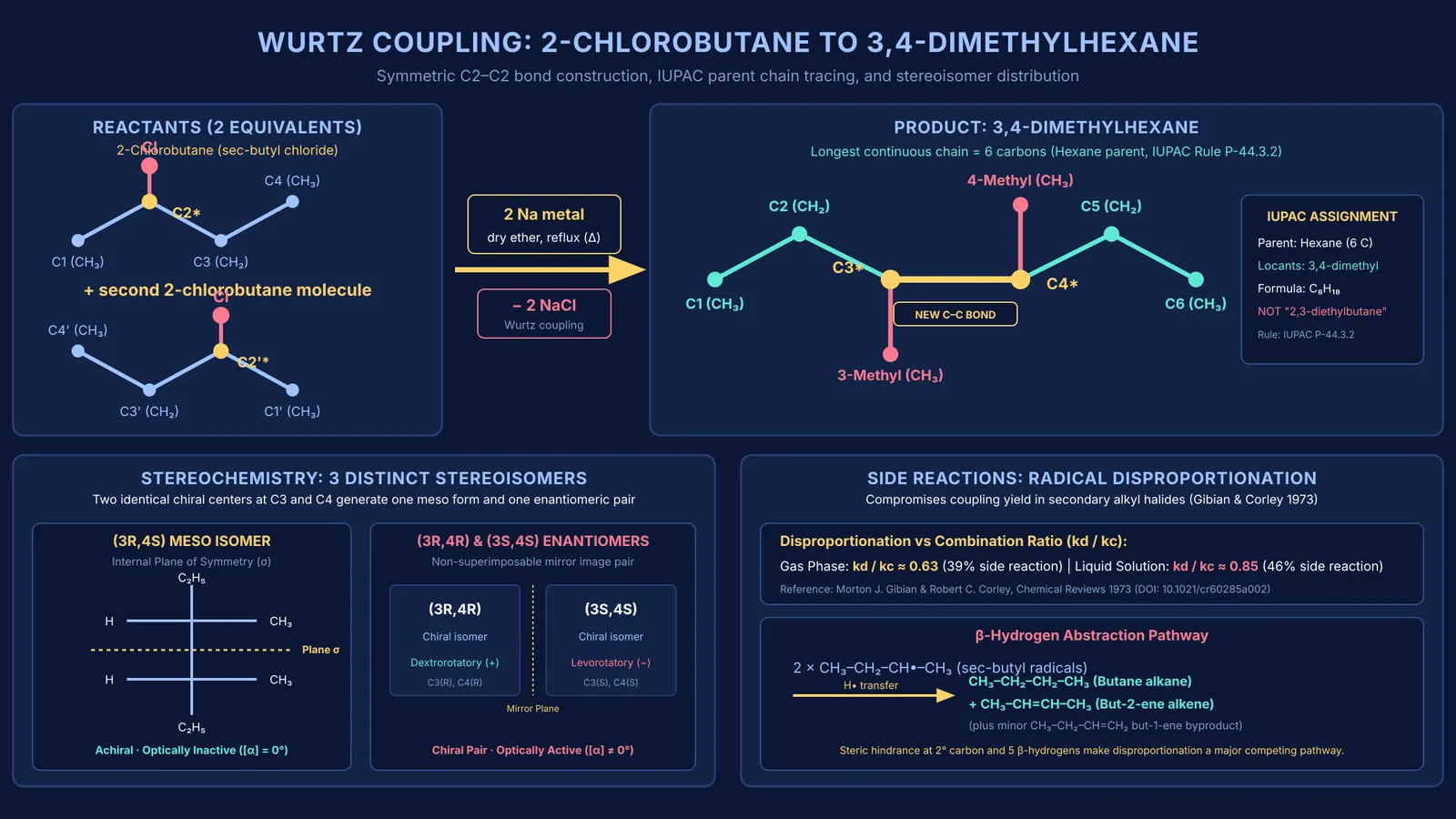
To convert 2-chlorobutane into 3,4-dimethylhexane, treat the secondary alkyl halide with metallic sodium in refluxing anhydrous dry ether. This transformation is a symmetric Wurtz coupling, joining two four-carbon secondary butyl fragments at their halogenated secondary carbons into an eight-carbon branched alkane framework.
How do you convert 2-chlorobutane to 3,4-dimethylhexane?
The conversion proceeds through the Wurtz reaction, first reported by French chemist Charles-Adolphe Wurtz in his 1855 study in *Justus Liebigs Annalen der Chemie*. When two equivalents of 2-chlorobutane react with two equivalents of sodium metal in dry ether, a carbon–carbon single bond links the two C2 positions:
2 CH₃–CH(Cl)–CH₂–CH₃ + 2 Na → CH₃–CH₂–CH(CH₃)–CH(CH₃)–CH₂–CH₃ + 2 NaCl
In the radical mechanism, metallic sodium acts as a single-electron reducing agent. Sodium donates an electron to the carbon–chlorine bond, generating a secondary butyl radical (CH₃–CH₂–CH•–CH₃) and sodium chloride. Two secondary butyl radicals then couple at their radical centers to form the dimer. Alternatively, in the ionic pathway, sodium transfers two electrons to form an organosodium intermediate, sec-butylsodium (CH₃–CH₂–CH(Na)–CH₃), which displaces chloride from a second 2-chlorobutane molecule via nucleophilic substitution.
The NCERT textbook portal for Class 12 Chemistry covers the Wurtz reaction under haloalkane reactions with metals as a core synthetic method for carbon-chain extension. The CBSE Senior Secondary Curriculum frequently pairs this haloalkane coupling with related reactions, such as Wurtz-Fittig and Fittig coupling reactions, to test reaction mechanisms across aliphatic and aromatic halides.
Why is the product 3,4-dimethylhexane instead of 2,3-diethylbutane?
A frequent error in nomenclature problems is calling the coupled alkane "2,3-diethylbutane." When students draw two secondary butyl fragments joined at their C2 positions as CH₃–CH(C₂H₅)–CH(C₂H₅)–CH₃, they often mistake the horizontal four-carbon sequence for the parent chain.
This mistake violates the foundational rules of organic nomenclature. Under Rule P-44.3.2 of the IUPAC Blue Book, *Nomenclature of Organic Chemistry: IUPAC Recommendations and Preferred Names 2013*, the principal chain in an acyclic hydrocarbon must be the longest continuous sequence of carbon atoms. Tracing the continuous path reveals six carbons:
Carbon 1: Terminal methyl of the first ethyl group (–CH₃)
Carbon 2: Methylene carbon of the first ethyl group (–CH₂–)
Carbon 3: First coupling carbon with a methyl branch (–CH(CH₃)–)
Carbon 4: Second coupling carbon with a methyl branch (–CH(CH₃)–)
Carbon 5: Methylene carbon of the second ethyl group (–CH₂–)
Carbon 6: Terminal methyl of the second ethyl group (–CH₃)
Because the longest continuous path contains six carbon atoms, the parent alkane is hexane. Numbering from either direction gives locants 3 and 4 for the two methyl substituents. Combining the locants with the prefix yields 3,4-dimethylhexane as the Preferred IUPAC Name. Reviewing the basic structural isomers of butane reinforces how branching patterns alter parent chain selection.
The Fermi Concept Library covers every concept in physics, chemistry, biology, mathematics and computing, each with its own lesson and its place in the map, helping you master IUPAC nomenclature rules and carbon-skeleton analysis.
What side products form during the coupling?
While primary alkyl halides like 1-chlorobutane give high coupling yields, secondary halides like 2-chlorobutane produce significant alkene and alkane byproducts through competing side reactions.
In secondary alkyl radicals, steric hindrance at the radical center slows direct dimerization. At the same time, the radical possesses beta-hydrogens accessible for abstraction. In a review in *Chemical Reviews*, Morton J. Gibian and Robert C. Corley documented that secondary butyl radicals display a disproportionation-to-combination rate ratio of approximately 0.63 in the gas phase and up to 0.85 in liquid solutions.
This kinetic ratio means that roughly 39% to 46% of collisions between two secondary butyl radicals do not yield the coupled dimer. Instead, one radical abstracts a beta-hydrogen from the second:
2 CH₃–CH₂–CH•–CH₃ → CH₃–CH₂–CH₂–CH₃ + CH₃–CH=CH–CH₃
The disproportionation products are butane alongside but-2-ene and but-1-ene. In the ionic pathway, the strongly basic sec-butylsodium can also deprotonate 2-chlorobutane via E2 elimination, forming additional alkene. Consequently, practical laboratory yields of 3,4-dimethylhexane remain modest.
How many stereoisomers does 3,4-dimethylhexane have?
Because 2-chlorobutane contains a stereocenter at C2, the reaction uses a mixture of (2R)-2-chlorobutane and (2S)-2-chlorobutane. Coupling links two chiral units, giving 3,4-dimethylhexane two stereocenters at C3 and C4.
Because both stereocenters carry identical sets of substituents—hydrogen, methyl, ethyl, and the other sec-butyl half—internal symmetry reduces the isomer count:
An enantiomeric pair: (3R,4R)-3,4-dimethylhexane and (3S,4S)-3,4-dimethylhexane, which are nonsuperimposable mirror images and optically active.
A meso isomer: (3R,4S)-3,4-dimethylhexane, which has an internal plane of symmetry in its eclipsed conformation and an inversion center in its anti conformation, making it optically inactive.
Rather than the four stereoisomers expected for an asymmetric molecule with two chiral centers, 3,4-dimethylhexane exists as three stereoisomers: one meso compound and one enantiomeric pair. Our guide on counting stereoisomers across chiral centres explains how molecular symmetry simplifies stereoisomer counts.
The Fermi Problem Library provides worked problems with a step-by-step solver that explains the reasoning rather than printing an answer, helping you work through organic mechanisms and stereochemical assignments.
Step-by-step conversion checklist
When solving alkyl halide coupling and nomenclature problems, apply this checklist:
Verify halide grade: Check if the haloalkane is primary, secondary, or tertiary to predict whether coupling or elimination dominates.
Connect reactive carbons: Form the new C–C bond directly between the carbons bearing the halogen leaving groups.
Find the longest carbon chain: Trace all continuous carbon sequences to identify the parent alkane, applying IUPAC Rule P-44.3.2.
Assign lowest locants: Number from the end that gives the lowest position numbers to substituent branches.
Audit stereocenters and symmetry: Count newly formed chiral centers and evaluate internal symmetry to find meso forms.


